Welcome to meidicross the leading medical facility for the health of you and your family.
Welcome to meidicross the leading medical facility for the health of you and your family.


Last updated: June 02,2026
Your ECG report comes back normal. The doctor nods. You exhale. Relief.
But then — why are you still breathless climbing one flight of stairs? Why does your chest feel oddly heavy during your evening walk? Why does something still feel off?
Here is a clinical truth that most patients are never told: a normal resting ECG can miss a coronary artery blockage of up to 50%. Your heart at rest is a quiet engine — it hides its problems well. It is only when you stress that engine that the hidden fault lines appear.
This is exactly what a Treadmill Test in Pune — commonly called a TMT or stress test — is designed to reveal. And for thousands of patients in Pune who walk away from an ECG feeling falsely reassured, this single test is the difference between early detection and a preventable heart attack.
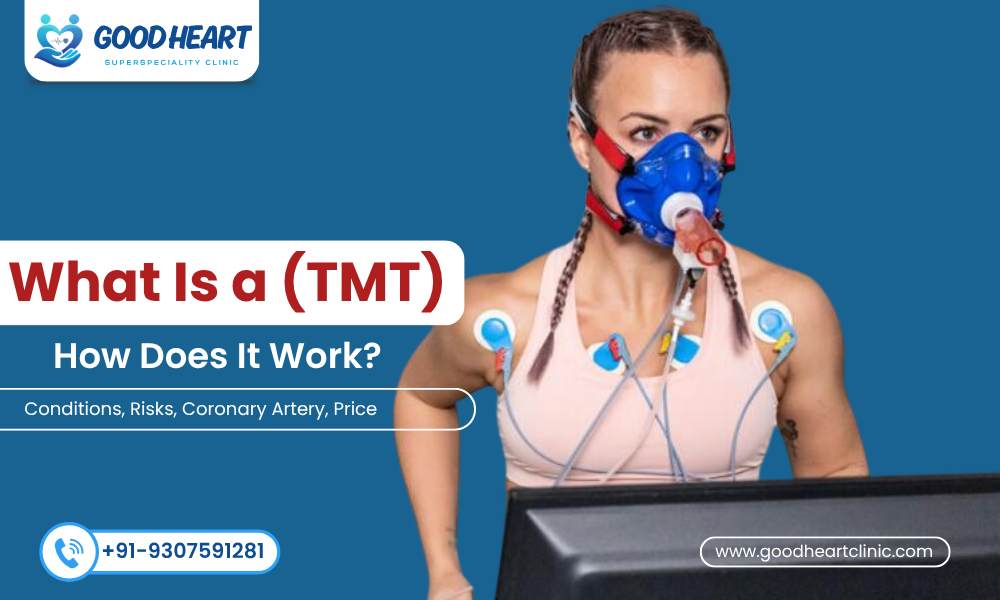
A Treadmill Test is a cardiac stress test. You walk on a treadmill while your heart rate, blood pressure, and electrical activity are continuously monitored through ECG leads attached to your chest. The speed and incline of the treadmill increase gradually — pushing your heart to work harder, stage by stage, under a controlled protocol called the Bruce Protocol.
When your heart is at rest, even a significantly narrowed artery can supply enough blood to keep things running smoothly. ECG at rest picks up nothing unusual. This is the dangerous gap.
The moment physical demand increases — during exertion, exercise, or even emotional stress — that narrowed artery cannot deliver the extra blood the heart muscle needs. The resulting oxygen shortage shows up as tell-tale changes in your ECG waveform, as a drop in blood pressure, or as reproducible symptoms like chest pain or breathlessness. These signals are invisible on a resting test and crystal-clear on a TMT.
Think of it this way: a crack in a bridge is not visible when one car crosses. Send twenty cars across simultaneously, and the crack becomes undeniable.
Key signals a TMT captures that a resting ECG misses:
For deeper context on understanding heart symptoms and when to act on them, our patient education library covers the full spectrum of cardiac warning signs.
The entire test takes approximately 30 to 45 minutes. There is no radiation, no injections, no fasting required. It is non-invasive, low-risk, and extraordinarily informative.
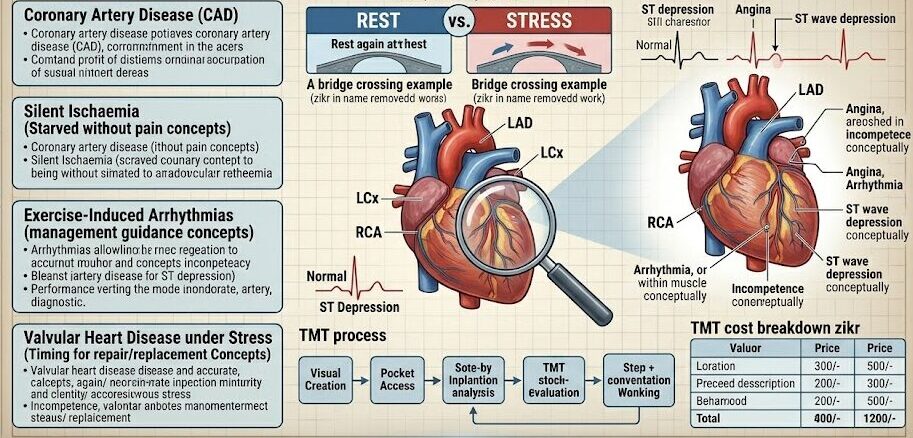
A Treadmill Test in Pune is not just a screening tool. Its results directly guide treatment decisions. Here is what a positive or abnormal TMT may reveal, and what happens next:
The most common finding. Partial blockages in the coronary arteries that restrict blood flow during exertion. Depending on the severity of TMT findings, treatment ranges from optimized medications (statins, beta-blockers, nitrates) and lifestyle modification to coronary angiography to map the blockage precisely.
A particularly dangerous condition — the heart muscle is starved of oxygen under stress, but the patient feels no pain. No symptoms. No warning. A positive TMT is often the only way this is caught before it progresses to a heart attack. Treatment typically involves medication and close follow-up, with interventional options if angiography confirms significant disease.
Some patients develop dangerous heart rhythm disturbances only during physical exertion. These require further electrophysiology evaluation and may be managed with medications, lifestyle changes, or in some cases an ablation procedure or pacemaker.
Mild valve problems invisible at rest can reveal their true severity when the heart is pushed. This informs decisions on timing of valve repair or replacement.
For patients with known heart disease, diabetes, hypertension, or a family history of cardiac events, the TMT is used to stratify risk — determining who needs urgent intervention versus who can be safely managed medically.
Explore our patient education resources to understand how each of these conditions is managed at our clinic, with real patient context and clinical clarity.
According to the American Heart Association, exercise stress tests are a cornerstone diagnostic tool in identifying coronary artery disease — particularly in patients with atypical or exertional symptoms that do not present at rest.
Not all treadmill tests are equal. The machine matters. But the cardiologist interpreting the results matters far more.
At Good Heart Clinic, every TMT is reviewed by Dr. Harshal Ingle — MD (Medicine), DrNB Cardiology, Interventional Cardiologist with over a decade of complex cardiac experience at Ruby Hall Clinic, Pune. He is not just a test administrator. He is the cardiologist who will sit with you, explain what the waveforms mean in plain language, and tell you honestly — and without rushing — what your next step should be.
Clinical expertise behind every reading. A TMT result is only as good as the cardiologist reading it. Subtle ST changes, borderline responses, and equivocal findings require experience to interpret correctly. Misreading a “borderline positive” as normal is how early blockages get missed for another year.
No unnecessary referrals or procedures. Dr. Ingle’s approach is evidence-based and conservative where possible. If your TMT is negative and your symptoms have another explanation, you will be told that — not pushed toward an angiogram you do not need.
Unhurried consultations. Every patient who has sat across from Dr. Ingle describes the same thing: he listens, he explains, and he never makes you feel like a number. In a city where cardiologists often see 50+ patients a day, this matters enormously.
Recognized clinical excellence. Dr. Ingle received the Excellence in Healthcare Award 2025 in Cardiology, presented by Maharashtra’s Health Minister and the Chief Cardiologist of Ruby Hall Clinic. He has performed the first Orbital Atherectomy and first Renal Denervation cases in Pune — milestones that speak to the caliber of care at this clinic.
Clinic track record:
One of the most searched questions before booking a TMT is: “How much does a Treadmill Test cost in Pune?” Here is an honest answer.
| What You Are Paying For | Approximate Cost Range |
|---|---|
| TMT (Treadmill Test) — standalone | ₹1,200 – ₹2,500 |
| TMT with cardiologist consultation | ₹1,800 – ₹3,500 |
| TMT + ECG + Echo package | ₹4,000 – ₹8,000 |
| Advanced stress echocardiography | ₹5,000 – ₹10,000 |
What influences the final cost:
There are no hidden charges at Good Heart Clinic. The price you are quoted is the price you pay.
A Treadmill Test is a cardiac stress test where you walk on a treadmill at increasing speeds while your ECG, heart rate, and blood pressure are monitored. It detects reduced blood flow and arrhythmias that only appear when the heart is under physical stress — conditions a resting ECG cannot reliably identify.
Not always. A resting ECG is taken when your heart is at minimal demand. Coronary blockages of up to 50% may produce no changes on a resting ECG. A Treadmill Test in Pune stresses the heart deliberately to surface these hidden problems before they cause a heart attack.
Anyone experiencing breathlessness, chest discomfort, or unusual fatigue during physical activity — especially with a normal or borderline ECG. Also recommended for patients with diabetes, hypertension, high cholesterol, a family history of heart disease, or those above 40 years old with cardiac risk factors.
The active walking portion takes 8–15 minutes depending on your fitness level and protocol stage. Including preparation and post-test monitoring, the total appointment is approximately 30–45 minutes.
No. A TMT is non-invasive and generally very safe. It is performed under cardiologist supervision with resuscitation equipment on standby. The test is stopped immediately if any concerning symptoms or ECG changes appear. Serious complications during a supervised TMT are extremely rare.
A positive TMT typically indicates reduced blood flow to the heart muscle during exertion — usually caused by one or more partially blocked coronary arteries. It does not mean you need immediate surgery. It means you need a coronary angiography to precisely map the blockage and determine the right treatment.
A standalone TMT in Pune costs approximately ₹1,200 to ₹2,500. When combined with a senior cardiologist consultation, the range is ₹1,800 to ₹3,500. Insurance coverage often applies — check your mediclaim policy beforehand.
You should avoid heavy meals for at least 3 hours before the test. Light food 2–3 hours prior is acceptable. Stay hydrated. Avoid caffeine on the day of the test. Wear comfortable shoes and loose clothing suitable for walking.
Yes, in most cases — but your blood pressure will be monitored continuously throughout. If your BP is severely uncontrolled (above 180/110) on the day of the test, it may be rescheduled until it is better managed. Your cardiologist will assess this before starting.
A TMT assesses your heart’s electrical and functional response to physical stress. An Echocardiogram provides a real-time ultrasound image of your heart’s structure and pump function at rest. They are complementary tests — and in some cases, a stress echocardiogram combines both to give a complete picture of how your heart performs under load.
A normal ECG is not a clean bill of cardiac health. It is one data point from one moment in time. If your body is telling you something — breathlessness, fatigue, an unexplained heaviness in your chest — that signal deserves a proper investigation.
A Treadmill Test in Pune at Good Heart Clinic is not just a test. It is the conversation between your heart and a cardiologist who knows how to listen. Dr. Harshal Ingle and the team are ready to give you answers that matter — honest, thorough, and without the rush.
Book your TMT consultation today. Your heart is worth the hour.
Morning OPD — Cardiac OPD C7, Ground Floor, Building 3, Ruby Hall Clinic, Pune 411001 Evening OPD — 303A, Choice Apartments, Opp. Vohuman Cafe, Dhole Patil Road, Pune 411001 Appointments: 9822055445 / 8208950831 Cardiac Emergency: 9697020666 / 7722031119
OPD Timings: Monday to Saturday | Morning: 10 AM – 4 PM | Evening: 4 PM – 8 PM
We believe that every patient deserves absolute confidence in their care plan.
303, A, Choice Apartments Opp Vohuman Cafe , Dhole Patil Road , Pune
Support mail: drharshalingle@gmail.com
Opening Hours: Mon -Sat: 04.00 PM to 08.00 PM