Welcome to meidicross the leading medical facility for the health of you and your family.
Welcome to meidicross the leading medical facility for the health of you and your family.


Last updated: June 30, 2026
Q: How long is recovery after coronary angioplasty?
A: Most patients go home the same day or next morning after angioplasty. Light activity resumes within 2–3 days. Desk work within 1–2 weeks. Driving after 1 week (radial access). Full normal activity by week 4–6. Complete cardiac recovery — including stent stabilisation — takes approximately 3 months.
Q: What Indian foods are safe to eat after angioplasty?
A: Safe Indian foods after angioplasty: dal, sabzi cooked in minimal oil, roti (1–2), brown rice, oats, poha, idli, curd (low-fat), fruits (banana, papaya, apple), and fish. Avoid: poori, paratha, ghee in excess, pickle, papad, fried snacks, and full-fat dairy for the first month.
Q: Can I stop my blood thinner tablet after angioplasty?
A: Never stop without doctor’s approval. Dual antiplatelet therapy (aspirin + clopidogrel/ticagrelor) must continue for a minimum of 6–12 months after a drug-eluting stent. Stopping early — even once — dramatically increases the risk of stent thrombosis, which can cause a fatal heart attack.
Q: When should I go to hospital after angioplasty?
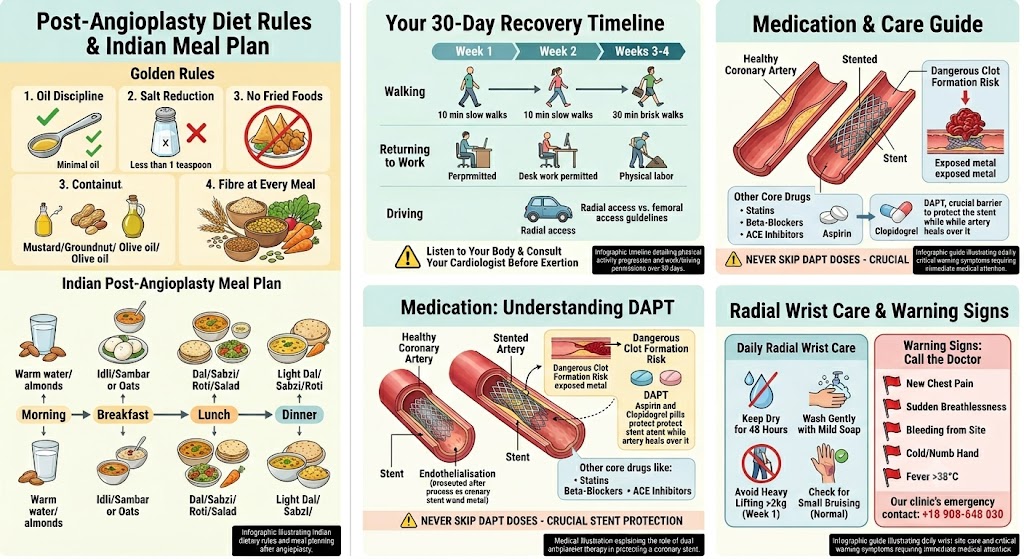
A: Go immediately if your patient develops: new chest pain or tightness, sudden breathlessness at rest, dizziness or fainting, swelling or bleeding at the wrist site, fever above 38°C, or cold/numb hand on the procedure side. Do not wait — call the cardiac emergency number directly.
Q: When can a patient walk after angioplasty?
A: Same day — within 2–4 hours of a radial (wrist) angioplasty. Short, slow walks around the ward or home are encouraged from day one. By week 2, a 15–20 minute walk daily is the target. By week 4–6, 30-minute brisk walks are typically safe with cardiologist clearance.
The cardiologist said it went perfectly. The family exhaled in the waiting area. And now everyone is home — your father is on the sofa, looking tired but stable, and you are standing in the kitchen holding a bag of groceries wondering: what exactly can he eat tonight?
No one told you. Not properly.
Life after angioplasty is not complicated — but it requires a clear plan. What to feed the patient, when to let them walk, which medicines must never be skipped, what warning signs require an emergency call, and how to move from Day 1’s careful rest to Day 30’s gradual return to normal life.
This blog is that plan. Written for the son who is managing his father’s discharge at home. The daughter who is Googling “diet after angioplasty” at midnight. The spouse who needs to know what is safe and what is not — without medical jargon, without ambiguity, and without the anxiety of not knowing.
Day by day. Meal by meal. Medicine by medicine. Here is everything your family needs to navigate the first 30 days after a stent — and beyond.
In the first 72 hours after angioplasty, the body is healing at the arterial access site, the newly stented coronary artery is stabilising, and the stent’s drug coating is beginning to suppress the inflammatory response that could otherwise trigger restenosis. This is the most critical window — and the quietest.
Your patient feels tired. This is normal and expected. The procedure, the sedation, the emotional weight of a cardiac event, and the body’s healing response all contribute to a fatigue that is not weakness — it is recovery.
The stent — a fine metal mesh now permanently expanded inside the coronary artery — is being covered by a thin layer of endothelial cells as the artery heals. This process, called endothelialisation, takes 3–6 months to complete. During this period, the stent surface is partially exposed metal in contact with flowing blood — which is why antiplatelet medications are absolutely non-negotiable. Without them, a clot can form on the exposed metal surface and block the artery completely.
At the wrist (radial) access site, the small puncture in the radial artery is sealed by a clot that gradually matures into scar tissue over 5–7 days. The compression band applied after the procedure facilitates this sealing — which is why the wrist must be kept dry and pressure must not be applied to the site during the first week.
The priority this week is simple: take every medicine on time, rest without being completely sedentary, and watch for warning signs.
Daily routine:
What is safe this week:
What must be avoided:
Wrist site care:
By Day 8, the wrist site is healing well, medicines are part of the daily routine, and the patient is ready to gradually increase activity.
Walking target: 15–20 minutes daily, outdoors if the weather is suitable. Flat ground preferred. Stop and rest if any chest discomfort, unusual breathlessness, or dizziness appears.
Returning to desk work: Most patients with office jobs can return to light work from home by Day 8–10. If the commute requires driving or significant travel, discuss timing with the cardiologist.
Driving: For radial (wrist) angioplasty, driving is typically permitted from Day 7–10 once the wrist is comfortable and full hand movement has returned. For femoral (groin) access, wait until Day 14.
Sleep position: No restriction — whichever position is comfortable. Some patients find sleeping on the left side (pacemaker/access side) uncomfortable in Week 1 — this usually resolves.
First follow-up visit: Most cardiologists schedule the first post-procedure appointment at 1–2 weeks. This visit includes wound review, medication adjustment if needed, ECG, and blood pressure check. Do not miss this appointment.
By Week 3, the patient should feel meaningfully better than they did before the procedure — the restored blood flow has had time to improve heart function and exercise tolerance.
Walking target: 25–30 minutes daily. Begin to increase pace gently. If the patient can hold a conversation while walking without breathlessness, the intensity is appropriate.
Returning to full-time work: Office return is appropriate for most desk-based professionals by Day 14–21. Jobs involving physical labour, heavy lifting, or significant exertion need longer — discuss with the cardiologist.
Light exercise: Gentle yoga (no inversions or breath-holding), stretching, and slow cycling on a stationary bike are typically safe by Week 3–4 with cardiologist guidance. Gym workouts, weight training, and high-intensity exercise wait until after the 1-month review.
Emotional recovery: This is real and often underestimated. Many patients experience anxiety, depression, or a persistent fear of another cardiac event in the weeks following angioplasty. This is well-documented and common. If the patient seems withdrawn, excessively fearful of any physical activity, or is sleeping poorly due to anxiety — mention this at the follow-up. Cardiac rehabilitation programmes, counselling, and structured support significantly improve outcomes.
According to the American Heart Association, cardiac rehabilitation — structured exercise, dietary guidance, and psychological support — reduces the risk of a second cardiac event by up to 25% and improves quality of life significantly for post-angioplasty patients.
Life after angioplasty requires a heart-healthy diet that reduces LDL cholesterol, controls blood pressure, manages blood sugar, and limits the sodium and saturated fat that accelerate coronary artery disease — all within the framework of Indian home cooking that your family actually knows how to prepare.
This is not a foreign diet. It is a modified version of what most Indian families already eat — with specific adjustments that make a measurable difference to cardiac outcomes.
Rule 1: Oil discipline. The type and quantity of cooking oil is the single most impactful dietary change for cardiac patients. Use a maximum of 2–3 teaspoons of oil per person per day. Choose oils high in monounsaturated or polyunsaturated fats — mustard oil, groundnut oil, or olive oil for tempering. Avoid vanaspati, dalda, coconut oil in excess, and reused/repeatedly heated oil.
Rule 2: Salt reduction — immediate and sustained. Excess sodium raises blood pressure and increases fluid retention — both dangerous in the post-stent period. Target less than 4–5 grams of salt per day (approximately 1 teaspoon total including all food). Eliminate: pickle, papad, namkeen, packaged snacks, sauces, and added table salt. Use lemon juice, coriander, and spices to add flavour without sodium.
Rule 3: Eliminate fried food for the first 30 days. Poori, bhatura, samosa, pakoda, paratha made with excess ghee — these are temporarily removed. Not forever, but for the first month when the stent is stabilising and inflammation is being suppressed. After Day 30, occasional indulgence can be discussed with the cardiologist.
Rule 4: Fibre at every meal. Whole grains (brown rice, multigrain roti, oats), pulses (all dals, rajma, chana), and vegetables increase fibre intake that actively lowers LDL cholesterol. Aim for at least 5 servings of vegetables and 2–3 servings of fruit daily.
Early Morning (6–7 AM):
Breakfast (8–9 AM) — choose one:
Mid-Morning (11 AM):
Lunch (1–2 PM):
Evening Snack (4–5 PM):
Dinner (7–8 PM) — lighter than lunch:
Bedtime (if hungry):
| Category | Best Choices |
|---|---|
| Grains | Oats, brown rice, multigrain roti, jowar, bajra |
| Protein | All dals, rajma, chana, tofu, egg whites, fish (2x/week) |
| Vegetables | All — especially leafy greens, broccoli, carrots, beets |
| Fruits | Apple, papaya, guava, pear, pomegranate, berries |
| Fats | Walnuts, almonds (5–6/day), flaxseeds, olive oil |
| Dairy | Low-fat curd, skimmed milk, paneer in moderation |
| Avoid / Reduce | Why |
|---|---|
| Ghee, butter, vanaspati | Saturated fat — raises LDL directly |
| Full-fat dairy (malai, cream) | High saturated fat content |
| Red meat (mutton, beef) | Saturated fat + haem iron — atherogenic |
| Processed/packaged foods | Hidden sodium, trans fats, preservatives |
| Pickle, papad, namkeen | Extremely high sodium |
| White bread, maida products | Refined carbs — spike blood sugar, raise triglycerides |
| Sweetened drinks, juices | Empty calories, blood sugar spikes |
| Alcohol | Raises triglycerides, interacts with antiplatelet medication |
For a complete guide to understanding long-term heart care after a stent procedure — including how diet, exercise, and medication work together to protect the stent long-term — our patient education library covers every aspect of post-angioplasty life.
The medication prescribed after angioplasty is not optional — it is the primary reason the stent continues to function. Life after angioplasty without consistent medication adherence is not recovery. It is risk.
1. Aspirin (75–150mg) — Every day, lifelong Aspirin prevents platelets from clumping together and forming clots inside the stent. It must be taken every single day — including days when the patient feels completely well — for life. It is cheap, widely available, and irreplaceable. Missing aspirin is not “one missed day.” It is a window of increased clotting risk.
2. Clopidogrel / Ticagrelor / Prasugrel — Every day for 6–12 months minimum The second antiplatelet drug works alongside aspirin — this combination is called Dual Antiplatelet Therapy (DAPT). Together, aspirin and clopidogrel (or ticagrelor) reduce the risk of stent thrombosis dramatically during the critical period while the stent is still being covered by the artery’s healing cells. The minimum duration is 6 months for drug-eluting stents; most cardiologists extend this to 12 months. Stopping this medication prematurely — even once — for any reason including a minor dental procedure or surgery — requires explicit cardiologist guidance. Never self-stop.
3. Statin (Atorvastatin 40–80mg or Rosuvastatin 20–40mg) — Every night, lifelong The statin is not just a cholesterol pill. At high doses, statins actively stabilise coronary plaque, reduce arterial inflammation, and slow the progression of atherosclerosis throughout the coronary tree — not just at the stented segment. Target LDL-C below 70 mg/dL (below 55 mg/dL for very high-risk patients). Take at night for best efficacy.
4. Beta-Blocker (Metoprolol / Bisoprolol) — As prescribed Beta-blockers reduce heart rate and blood pressure, decrease myocardial oxygen demand, and protect against post-MI arrhythmias. Duration of therapy depends on the indication — patients who had a heart attack typically continue for at least 1–3 years; others may have shorter courses.
5. ACE Inhibitor or ARB (Ramipril / Telmisartan) — As prescribed These medications reduce cardiac remodelling after a heart attack, protect kidney function in diabetics, and control blood pressure. They are particularly important for patients with reduced ejection fraction (pump function).
Print or write a simple table:
| Medicine Name | Dose | Morning | Afternoon | Night | With/Without Food |
|---|---|---|---|---|---|
| Aspirin | 75mg | ✅ | After food | ||
| Clopidogrel | 75mg | ✅ | After food | ||
| Atorvastatin | 40mg | ✅ | Either | ||
| Metoprolol | As prescribed | ✅ | ✅ | After food | |
| Ramipril | As prescribed | ✅ | After food |
Keep this chart on the refrigerator. Set phone alarms for every dose. Use a weekly pill organiser. Never run out — refill medicines at least 5 days before the supply finishes.
Life after angioplasty is generally safe and progressively improving — but specific symptoms require immediate medical attention and must never be waited out at home.
The procedure that placed your stent matters. But the follow-up that protects it matters equally. At Good Heart Clinic, the relationship does not end at discharge — it continues through every medication review, every follow-up ECG, every question that arises at 10 PM when the patient wakes up with an unfamiliar sensation in their chest.
Dr. Harshal Ingle — MD (Medicine), DrNB Cardiology, Interventional Cardiologist at Ruby Hall Clinic, Pune — provides the complete post-angioplasty care pathway: procedure, discharge planning, medication optimisation, follow-up imaging, and long-term cardiac risk management.
Explore the full range of advanced coronary angioplasty at Good Heart Clinic Pune — including how IVUS and OCT imaging are used to confirm optimal stent placement before the patient leaves the catheterisation laboratory.
Clinic credentials:
Most patients feel significantly better within 1–2 weeks as restored blood flow improves energy and exercise tolerance. Physical recovery — returning to normal daily activities — takes 4–6 weeks. Complete stent stabilisation (endothelialisation) takes approximately 3–6 months, which is why antiplatelet medications must continue through this entire period.
Heart-healthy Indian diet after angioplasty: multigrain roti, brown rice, all dals, sabzi with minimal oil, low-fat curd, fruits (2–3 daily), and fish (twice weekly). Reduce: ghee, full-fat dairy, red meat, fried foods, pickle, papad, and packaged snacks. Salt below 4–5g per day. Cook in 2–3 teaspoons of oil maximum.
Yes — from Day 1, one flight at a time, slowly. Climbing stairs is actually a useful gauge of recovery progress. By Week 2, two to three flights without significant breathlessness is a reasonable target. If stair climbing causes chest tightness or disproportionate breathlessness, report this at the follow-up appointment.
Sexual activity is generally safe 1–2 weeks after uncomplicated angioplasty — equivalent to the exertion of climbing two flights of stairs. If the patient can walk briskly for 10 minutes without chest pain or breathlessness, sexual activity is usually safe. Always confirm with the cardiologist at the first follow-up visit.
If one dose of clopidogrel or ticagrelor is missed, take it as soon as remembered — unless it is almost time for the next dose, in which case skip the missed dose and continue the normal schedule. Never double-dose. If more than one or two doses are missed, call the cardiologist the same day. Do not wait.
Air travel is generally safe 2–4 weeks after uncomplicated angioplasty. The pressurised cabin environment is not itself a cardiac risk. Longer flights (above 4 hours) carry a DVT risk — encourage walking in the aisle every 2 hours and adequate hydration. Carry the complete medication list and discharge summary. Confirm with the cardiologist before booking.
Not permanently banned, but significantly restricted for the first 30 days. After the initial recovery period, small quantities of desi ghee (1/4 teaspoon on roti occasionally) are unlikely to cause harm in the context of an otherwise heart-healthy diet. The total saturated fat intake — from all sources — is what matters. Discuss with Dr. Harshal Ingle at the follow-up.
The first ECG and clinical review are typically done at 1–2 weeks post-procedure. A lipid panel and blood glucose check are done at 4–6 weeks to assess medication effectiveness. A follow-up echocardiogram or stress test may be scheduled at 3 months. All timings are specified in the discharge instructions — follow them precisely.
Drug-eluting stent angioplasty has a procedural success rate above 95–98% in experienced centres — 99.83% at Good Heart Clinic. Long-term patency depends on medication adherence, lifestyle changes, and LDL control. Patients who take their medicines consistently, eat well, exercise regularly, and attend follow-ups have outcomes comparable to people who never had a blockage.
The first 30 days after angioplasty are about healing. The next 30 years are about living — with a heart that has been repaired, supported by a stent, protected by medication, and nourished by the choices made at every meal and every walk.
Life after angioplasty is not a diminished life. For the majority of patients who commit to the medication, the diet, the follow-up, and the lifestyle adjustments — it is a better life than the one being lived before the blockage was discovered and treated.
Your family has done the hard part — getting through the procedure. Now comes the part that is just as important: the daily decisions that protect what the cardiologist worked to restore.
Dr. Harshal Ingle and the team at Good Heart Clinic are ready for every step of that journey — from the Day 1 discharge walk to the Year 3 annual review.
Book your post-angioplasty follow-up consultation today. Your stent is doing its job. Make sure everything around it is too.
Morning OPD — Cardiac OPD C7, Ground Floor, Building 3, Ruby Hall Clinic, Pune 411001 Evening OPD — 303A, Choice Apartments, Opp. Vohuman Cafe, Dhole Patil Road, Pune 411001 Appointments: 9822055445 / 8208950831 Cardiac Emergency: 9697020666 / 7722031119 goodheartclinic.com
OPD Timings: Monday to Saturday | Morning: 10 AM – 4 PM | Evening: 4 PM – 8 PM
We believe that every patient deserves absolute confidence in their care plan.
303, A, Choice Apartments Opp Vohuman Cafe , Dhole Patil Road , Pune
Support mail: drharshalingle@gmail.com
Opening Hours: Mon -Sat: 04.00 PM to 08.00 PM