Welcome to meidicross the leading medical facility for the health of you and your family.
Welcome to meidicross the leading medical facility for the health of you and your family.


Last updated: June 09,2026
Q: Is coronary angiography treatment Pune a surgery or a diagnostic test?
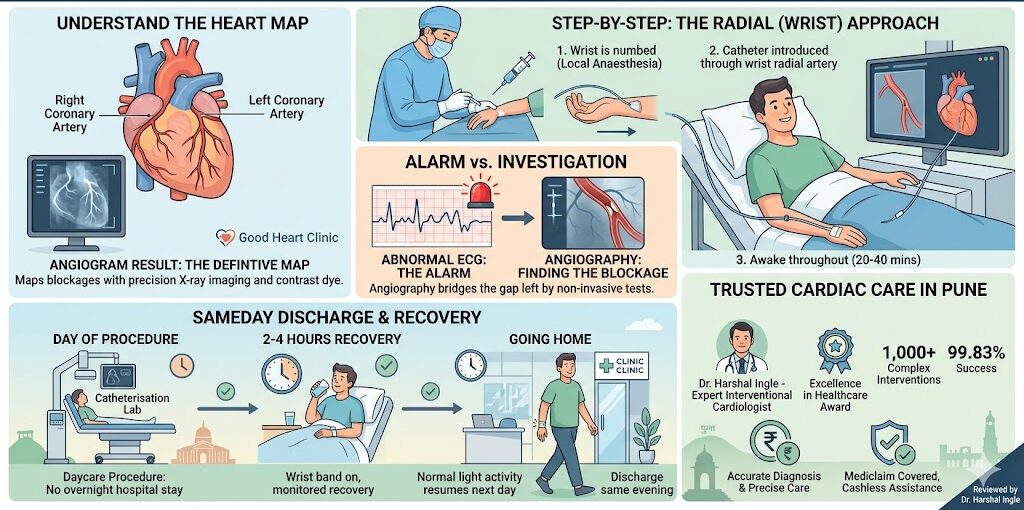
A: It is a diagnostic test, not surgery. Coronary angiography is a minimally invasive daycare procedure that maps coronary artery blockages using contrast dye and X-ray. No cuts, no stitches, no general anaesthesia — just a pin-hole access through the wrist.
Q: Why does the best cardiologist in Pune recommend angiography after an abnormal ECG?
A: An abnormal ECG suggests electrical or blood flow changes in the heart — but cannot show where the blockage is or how severe it is. Angiography provides the exact arterial map needed to decide between medication, stenting, or bypass surgery.
Q: How long is recovery after radial (wrist) angiography in Pune?
A: Same-day discharge in most cases. After 2–4 hours of monitored recovery, patients go home. The wrist compression band is removed within hours. Normal light activity resumes the next day. No bed rest, no overnight hospital stay required.
Q: Is coronary angiography painful?
A: No. The wrist is numbed with local anaesthesia before the procedure. Arteries have no pain receptors, so the catheter movement is completely painless. You may feel a brief warm sensation when contrast dye is injected — lasting only seconds.
Q: What is the cost of coronary angiography treatment in Pune?
A: Diagnostic coronary angiography in Pune costs approximately ₹15,000 to ₹30,000. Most mediclaim and corporate health insurance policies cover it fully. Pre-authorisation assistance is provided at Good Heart Clinic on the day of admission.

Your ECG came back abnormal. Or your Treadmill Test raised a red flag. And now your doctor has said the words — coronary angiography.
The moment most patients hear that word, a specific fear arrives: is this surgery? Will I be under general anaesthesia? Will I need to stay in hospital for days?
The answer to all three questions is no. And coronary angiography treatment Pune — performed through the wrist, under local anaesthesia, as a daycare procedure — is one of the safest, most informative diagnostic steps available in modern cardiology.
But fear is never irrational. It is simply a response to the unknown. This blog is written to replace the unknown with facts — so that when you arrive at the catheterisation laboratory, you know exactly what is about to happen, step by step, and why your cardiologist made this recommendation.
Coronary angiography is a diagnostic test — not a surgical operation. This distinction matters enormously, and most patients are never clearly told it.
Surgery involves cutting through tissue, operating under general anaesthesia, and requiring recovery measured in weeks. Coronary angiography involves a pin-hole puncture at the wrist, a thin catheter threaded through a blood vessel, and a procedure completed in 20–40 minutes while you are awake and comfortable. There are no scalpels, no stitches, no general anaesthesia, and no intensive care unit.
It is, in essence, a highly sophisticated internal imaging test — the cardiac equivalent of an MRI, but performed from inside the artery rather than from outside the body.
A cardiologist introduces a thin catheter — a flexible tube roughly 2mm in diameter — through a small sheath placed in the radial artery at the wrist. The catheter is guided under real-time X-ray imaging through the arterial system to the opening of the coronary arteries. A small amount of contrast dye is then injected directly into each coronary artery, and X-ray images capture the dye as it flows through the vessel.
The result is a precise anatomical map — showing every segment of every coronary artery, every point of narrowing, its exact location, its severity as a percentage, and the vessel anatomy on both sides of the blockage. This is information no other test provides, and it is the information your cardiologist needs before any treatment decision — medication, stenting, or surgery — can be made responsibly.
For a thorough explanation of understanding abnormal ECG results and next steps — including what different ECG abnormalities suggest and when angiography becomes the appropriate next investigation — our patient education library provides clear, jargon-free guidance.
The term daycare procedure means exactly what it sounds like: you arrive in the morning, have the procedure during the day, and go home in the evening. No overnight admission is required in the majority of straightforward diagnostic angiography cases. The catheterisation laboratory at Ruby Hall Clinic where Dr. Harshal Ingle operates is a tertiary care facility with full monitoring, resuscitation equipment, and specialist backup — but the procedure itself does not require the infrastructure of a surgical theatre.
An abnormal ECG tells your cardiologist that something is wrong with the heart’s electrical activity or blood supply — but it cannot tell them where the problem is, how severe it is, or what the right treatment should be.
This is the diagnostic gap that coronary angiography fills — and why the best cardiologist in Pune will recommend it when non-invasive tests suggest coronary artery disease but leave the picture incomplete.
An ECG records the electrical activity of the heart at rest. It can detect patterns that suggest reduced blood flow — ST-segment changes, T-wave abnormalities, Q-waves from prior heart damage — but it captures these as electrical shadows, not anatomical pictures. A significant coronary artery blockage can produce an abnormal ECG pattern. So can a completely different cardiac condition entirely unrelated to the coronary arteries.
The abnormal ECG is the alarm. The angiogram is the investigation that finds the fire.
In most cases, angiography is recommended after one or more of the following:
The common thread: non-invasive tests have raised a concern that cannot be resolved without direct visualisation of the coronary arteries. Angiography resolves that concern definitively — within a single 30-minute procedure.
Once the coronary map is in hand, the path forward becomes clear:
According to the American Heart Association, coronary angiography remains the gold standard reference investigation for coronary artery disease assessment — providing anatomical detail that no other currently available test can replicate.
Explore the range of advanced cardiac imaging at Good Heart Clinic — including intravascular imaging technologies that complement angiography for complex lesion assessment.
For radial (wrist) angiography, most patients are discharged the same day — within 2 to 4 hours of the procedure ending. There is no overnight hospital stay required in the majority of diagnostic cases.
This is perhaps the single most important practical fact about modern coronary angiography — and the one that surprises patients most when they hear it. Recovery is not measured in days or weeks. It is measured in hours.
Immediately after: The catheter is removed. A small compression band — a TR (Trans-Radial) band — is placed over the wrist puncture site and inflated to apply gentle pressure to seal the artery. You are moved from the catheterisation laboratory to a monitored recovery area.
0–2 hours post-procedure: You are sitting up, eating and drinking normally, and being monitored for heart rate, blood pressure, and the wrist site. The cardiologist reviews the angiogram images and, when you are stable, comes to explain the findings and the recommended next steps.
2–4 hours post-procedure: The TR band is gradually deflated and removed. The wrist puncture site — a small dot — is covered with a small dressing. Discharge paperwork, medication prescriptions, and a follow-up appointment are provided.
Same evening: You are home. You can eat normally, use the bathroom independently, and move around your house without restriction.
You can:
Avoid for 24 hours:
Return immediately if you notice:
For the vast majority of patients, none of these warning signs appear. The wrist site heals within 3–5 days. And the information from the angiogram — the arterial map that was worth the hour of procedure and monitoring — guides your cardiac care from that point forward with a clarity that was simply not available before.
The femoral (groin) approach — the traditional angiography access site — required 6–8 hours of flat bed rest post-procedure because the femoral artery is deep, large, and cannot be compressed manually. The radial artery at the wrist is superficial, smaller, and easily compressed. The TR band does the work that previously required hours of immobility.
This is not a minor quality-of-life improvement. For elderly patients, extended bed rest carries its own risks — deep vein thrombosis, pressure sores, urinary complications, and deconditioning. The radial approach eliminates these risks entirely.
When your cardiologist recommends a coronary angiogram, the quality of the procedure — the imaging equipment, the access technique, and critically, the experience of the cardiologist reading and acting on the results — determines what you get out of it.
Dr. Harshal Ingle — MD (Medicine), DrNB Cardiology, Interventional Cardiologist at Ruby Hall Clinic — has performed over 1,000 complex coronary interventions, including angiographies and angioplasties across the full spectrum of coronary disease complexity. He is a radial-first cardiologist by training and conviction — every eligible patient receives wrist-access angiography as the default.
Clarity before and after. Before the procedure, Dr. Ingle explains exactly what the angiogram will show, what the possible findings are, and what each finding would mean for treatment. After the procedure, he sits with the patient and family and walks through the actual images — pointing to the arteries, explaining the blockages in plain language, and laying out every treatment option before any decision is made.
No unnecessary escalation. A positive angiogram does not automatically mean a stent. At Good Heart Clinic, angiogram results showing mild disease are managed with optimised medications — because the evidence supports this approach and the patient’s long-term interests are not served by unnecessary intervention.
Pioneer-level technical capability for complex findings. When the angiogram reveals a complex lesion — heavily calcified, bifurcation, left main — Dr. Ingle has the intravascular imaging (IVUS, OCT) and atherectomy capability (Orbital Atherectomy, first in Pune) to treat it appropriately. Patients do not need a second referral.
National recognition: Excellence in Healthcare Award 2025 in Cardiology | India Live 2024 Presenter | First in Pune — Orbital Atherectomy and Renal Denervation.
Clinic credentials:
| Procedure | Approximate Cost (INR) |
|---|---|
| Diagnostic Coronary Angiography | ₹15,000 – ₹30,000 |
| Coronary Angiography + Same-Session Angioplasty | ₹1,00,000 – ₹2,50,000 |
| Pre-procedure cardiologist consultation | ₹500 – ₹1,500 |
| Pre-procedure investigations (ECG, blood tests, chest X-ray) | ₹2,000 – ₹6,000 |
| Post-procedure follow-up | ₹500 – ₹1,000 |
What influences cost:
Insurance: Diagnostic coronary angiography is covered under most mediclaim, corporate, and government health insurance schemes. Our team assists with pre-authorisation documentation from the day of admission — no last-minute paperwork surprises.
No. Coronary angiography is a minimally invasive diagnostic procedure performed through a pin-hole access at the wrist under local anaesthesia. There is no surgery, no general anaesthesia, no stitches, and no surgical recovery period. Most patients go home the same day within 2–4 hours of the procedure.
An ECG can detect electrical abnormalities suggesting coronary artery disease but cannot show the location or severity of any blockage. The best cardiologist in Pune recommends angiography to get the precise coronary artery map needed to decide whether treatment should be medication, stenting, or bypass surgery.
Yes — you are awake throughout the procedure, mildly sedated for comfort. You can speak to the catheterisation laboratory team, you will hear the equipment, and you may feel a brief warm flush when the contrast dye is injected. Most patients describe the experience as far less stressful than they anticipated.
The active procedure takes approximately 20–40 minutes for a standard diagnostic angiogram. If angioplasty is performed in the same session, total procedure time extends to 45 minutes to 1.5 hours. The total time from arrival to discharge is typically 4–6 hours including preparation and post-procedure monitoring.
You should fast for 4–6 hours before the procedure — typically from midnight if the angiogram is scheduled in the morning. Stay well hydrated with water until 2 hours before. Your pre-procedure instructions from Good Heart Clinic will specify the exact fasting window for your scheduled time.
ame-day discharge is the standard for radial angiography. You can walk, eat, and function normally from the same evening. Avoid heavy lifting with the wrist-side arm for 24 hours and keep the wrist dressing dry. Most patients return to desk work and light activity the following day.
Yes — coronary angiography uses X-ray imaging (fluoroscopy) to guide the catheter and capture arterial images. The radiation dose is comparable to a few months of natural background radiation and is not considered harmful for diagnostic angiography. The clinical benefit of the information obtained far outweighs this minimal exposure.
If the angiogram reveals a significant blockage that warrants intervention, your cardiologist will discuss the options with you immediately after the procedure — medication management, angioplasty (stenting), or surgical referral for bypass. In some cases, angioplasty is performed in the same session. In others, it is planned separately after a full discussion.
Yes. Radial angiography is particularly well-suited for elderly patients — no prolonged bed rest, minimal bleeding risk, and same-day discharge eliminate the complications associated with extended immobility. Dr. Harshal Ingle has extensive experience with elderly patients and comorbid conditions including diabetes and chronic kidney disease.
Diagnostic coronary angiography in Pune costs approximately ₹15,000 to ₹30,000. Most mediclaim and corporate health insurance policies cover the procedure. If angioplasty is performed in the same session, combined costs range from ₹1,00,000 to ₹2,50,000 depending on stent type. Pre-authorisation support is provided at Good Heart Clinic.
Before an angiogram, your cardiologist is working with partial information — an ECG pattern, a stress test result, a symptom history. They suspect coronary artery disease. They cannot confirm it, cannot grade it, and cannot responsibly recommend a treatment without seeing the arteries directly.
After an angiogram, every one of those unknowns is resolved. The blockages are mapped. The severity is graded. The treatment plan is evidence-based and specific to your anatomy. The uncertainty — which is usually more frightening than the diagnosis itself — is gone.
Coronary angiography treatment Pune at Good Heart Clinic is not something to fear or delay. It is the test that gives your cardiologist — and you — the information needed to protect your heart with confidence.
If you have been advised a cardiac scan, or if you are experiencing chest symptoms that have not yet been fully investigated, we invite you to take that next step today.
Book your consultation with Dr. Harshal Ingle. Walk in with an ECG report. Walk out with a plan.
Morning OPD — Cardiac OPD C7, Ground Floor, Building 3, Ruby Hall Clinic, Pune 411001 Evening OPD — 303A, Choice Apartments, Opp. Vohuman Cafe, Dhole Patil Road, Pune 411001 Appointments: 9822055445 / 8208950831 Cardiac Emergency: 9697020666 / 7722031119
OPD Timings: Monday to Saturday | Morning: 10 AM – 4 PM | Evening: 4 PM – 8 PM
We believe that every patient deserves absolute confidence in their care plan.
303, A, Choice Apartments Opp Vohuman Cafe , Dhole Patil Road , Pune
Support mail: drharshalingle@gmail.com
Opening Hours: Mon -Sat: 04.00 PM to 08.00 PM