Welcome to meidicross the leading medical facility for the health of you and your family.
Welcome to meidicross the leading medical facility for the health of you and your family.


Last updated: June 04,2026
The word “angiography” makes most patients nervous. Immediately, the mind goes to hospital beds, days of bed rest, and a groin incision they would rather not think about.
But coronary angiography treatment in Pune has changed significantly — and the change starts at the wrist.
At Good Heart Clinic, Dr. Harshal Ingle performs coronary angiography through the radial artery in the wrist — a technique that is clinically superior, dramatically more comfortable, and in most cases allows patients to walk out of the procedure suite and go home the same day. No prolonged bed rest. No femoral pressure. No overnight stay in the majority of standard cases.
If your cardiologist has recommended an angiogram, you deserve to know that how it is done matters as much as that it is done.

Coronary angiography is the most definitive diagnostic test for coronary artery disease. Using a thin, flexible tube called a catheter, a cardiologist injects a contrast dye directly into the coronary arteries while X-ray imaging captures real-time pictures. The result: a precise, undeniable map of every blockage — its exact location, its severity, and the anatomy around it.
No other test provides this level of detail. An ECG tells you something is wrong. An echocardiogram shows pump function. A Treadmill Test reveals that the heart is under stress. But a coronary angiogram tells you exactly where the problem is — down to the millimetre.
This is why it is called the gold standard. And why, when results from other tests are concerning, coronary angiography is the next logical step before deciding on treatment.
For deeper context on understanding coronary artery symptoms and how different cardiac tests relate to each other, our patient education library explains each stage of the diagnostic journey in plain language.
This is the part most patients are never explained — and it deserves a proper conversation.
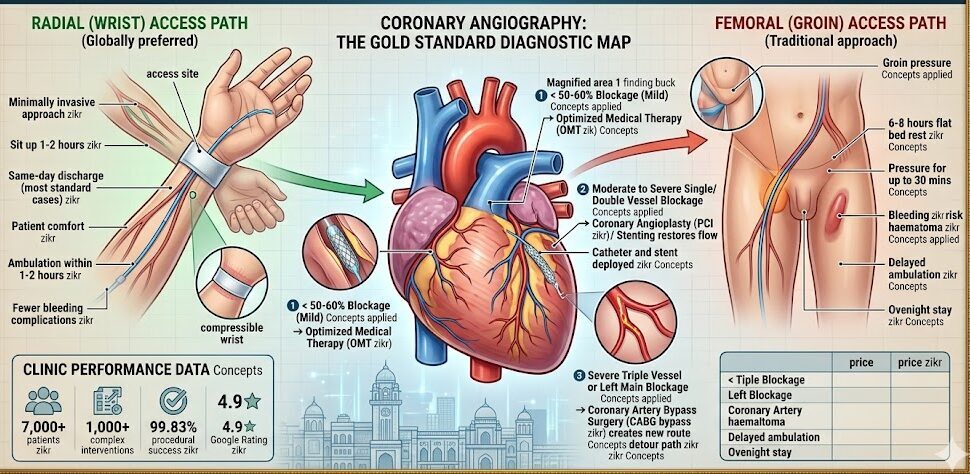
Traditionally, coronary angiography was performed via the femoral artery in the groin. The catheter was inserted at the top of the thigh, threaded up through the aorta, and into the heart. It worked. But it came with real drawbacks: mandatory bed rest of 6–8 hours post-procedure, pressure applied to the groin for up to 30 minutes, a meaningful risk of haematoma (internal bleeding at the puncture site), and significant patient discomfort — particularly for elderly patients and those with obesity or prior vascular disease.
The radial approach — through the wrist — changed all of this.
| Parameter | Femoral (Groin) Approach | Radial (Wrist) Approach |
|---|---|---|
| Access site | Groin / femoral artery | Wrist / radial artery |
| Post-procedure rest | 6–8 hours flat bed rest | Sit up within 1–2 hours |
| Bleeding risk | Higher — major vessel | Lower — compressible wrist |
| Patient comfort | Significant discomfort | Minimal discomfort |
| Same-day discharge | Rarely possible | Yes, in most standard cases |
| Ambulation after procedure | Delayed | Within 1–2 hours |
| Access site complications | Higher (haematoma, pseudoaneurysm) | Significantly lower |
According to the American Heart Association, radial access is now the globally preferred approach for coronary angiography and angioplasty, associated with fewer complications and better patient outcomes.
Before: A local anaesthetic cream is applied to the wrist. Within minutes, the area is numb. Most patients report feeling nothing more than mild pressure.
During: Dr. Ingle introduces a thin sheath into the radial artery. The catheter travels through the arterial system to the heart — you feel nothing, because arteries have no pain receptors. The contrast dye creates a brief warm sensation for a few seconds. Real-time X-ray images display your coronary arteries in complete detail on the monitor.
After: A small compression band is placed over the wrist. You are moved to a recovery area. Within 1–2 hours, you are sitting up, drinking water, and in most uncomplicated cases, preparing to go home. The wrist band is removed in a few hours. There is no need to lie flat, no groin wound to manage, no prolonged hospital stay.
The angiogram report directly determines what comes next. There is no guessing — the images make the decision clear.
No immediate intervention. Optimized medical therapy — statins, antiplatelets, blood pressure medications — combined with strict lifestyle changes. Close follow-up monitoring. This is the appropriate, evidence-based response. Not every blockage needs a stent.
Coronary Angioplasty (PCI) — a stent is deployed through the same radial access during the same sitting or in a planned second procedure. The blocked artery is opened, the stent holds it wide, and blood flow is restored. Recovery is rapid.
Coronary Artery Bypass Surgery (CABG) is typically recommended — discussed in detail with the patient and family before any decision is made. Dr. Ingle ensures patients understand every option before any surgical consent is considered.
Explore our cardiac patient guides for comprehensive explanations of what each treatment involves, in language designed for patients — not textbooks.
Dr. Harshal Ingle — MD (Medicine), DrNB Cardiology, Interventional Cardiologist — has performed over 1,000 complex cardiac interventions, including coronary angiographies and angioplasties, at Ruby Hall Clinic, Pune. He is among the most experienced radial-access interventional cardiologists in the city.
Radial-first by conviction, not convenience. Dr. Ingle transitioned to a radial-first approach not because it is trending, but because the clinical evidence is unambiguous — fewer bleeding complications, better patient comfort, faster recovery. Every eligible patient at Good Heart Clinic receives this approach as the default.
Pioneer-level technical expertise. Dr. Ingle is the first cardiologist in Pune to perform Orbital Atherectomy — a technique that safely clears heavily calcified, complex coronary blockages that standard angioplasty balloons cannot cross. He is also the first in Pune to perform Renal Denervation for resistant hypertension. These are not routine capabilities. They reflect a cardiologist who pursues technical advancement specifically to expand what is possible for his patients.
Recognized nationally. Presented at India Live 2024, the country’s premier interventional cardiology forum. Recipient of the Excellence in Healthcare Award 2025 in Cardiology, presented by Maharashtra’s Health Minister.
Honest, unhurried consultations. At Good Heart Clinic, your angiogram result is not handed to you in a corridor. Dr. Ingle walks through every image with you. You understand what was found, what it means, and what all your options are — before any decision is made.
Clinic credentials:
| Procedure / Service | Approximate Cost (INR) |
|---|---|
| Diagnostic Coronary Angiography | ₹15,000 – ₹30,000 |
| Coronary Angiography + Angioplasty (single vessel) | ₹90,000 – ₹1,80,000 |
| Coronary Angiography + Stenting (drug-eluting stent) | ₹1,20,000 – ₹2,50,000 |
| Pre-procedure cardiologist consultation | ₹500 – ₹1,500 |
| Post-procedure follow-up | ₹500 – ₹1,000 |
What influences cost:
Insurance: Most mediclaim and corporate health policies cover coronary angiography and angioplasty fully or substantially. Our team actively assists with pre-authorization to ensure claims go smoothly.
No hidden charges. The procedure cost you are quoted covers the full intervention — there are no surprise additions on your bill.
Coronary angiography is an X-ray imaging procedure that maps blockages inside the coronary arteries using a contrast dye. It is done when a patient has symptoms of coronary artery disease — chest pain, breathlessness, abnormal stress test results — to determine the location and severity of any blockages before deciding on treatment.
No. Coronary angiography through the wrist (radial approach) is performed under local anaesthesia. You will feel mild pressure during the catheter insertion and a brief warmth when the contrast dye is injected. The procedure itself is not painful. Most patients describe it as far easier than they expected.
Radial angiography uses the wrist artery as the entry point. Femoral angiography uses the groin. Radial access has lower bleeding risk, requires no prolonged bed rest, allows same-day discharge in most cases, and is significantly more comfortable for patients. It is now the globally preferred approach.
Yes — in the majority of straightforward diagnostic cases, same-day discharge is possible with the radial (wrist) approach. A few hours of monitoring post-procedure is standard, after which patients who are stable are discharged with clear instructions and follow-up scheduled.
Diagnostic coronary angiography in Pune costs approximately ₹15,000 to ₹30,000. If angioplasty is performed in the same session, the combined cost typically ranges from ₹90,000 to ₹2,50,000 depending on the number of vessels treated and stent type. Most health insurance policies cover this procedure.
No. Angiography is diagnostic — it maps the blockage. Angioplasty is therapeutic — it opens the blockage using a balloon and stent. Angioplasty is performed after angiography confirms that intervention is needed. In some cases, both are done in the same sitting. In others, angiography is done first and angioplasty is planned separately.
The procedure itself takes approximately 20 to 40 minutes for a standard diagnostic angiogram. If angioplasty is performed, the total time is 45 minutes to 1.5 hours. Recovery monitoring adds another 2–4 hours before discharge.
All invasive procedures carry some risk. For coronary angiography, serious complications — stroke, heart attack, major bleeding — are rare, occurring in less than 1% of cases in experienced centres. The radial approach further reduces bleeding complications compared to the femoral route. The benefit of accurately diagnosing coronary artery disease almost always outweighs this small procedural risk.
For the radial approach, full hospital admission is typically not required for diagnostic angiography. A daycare admission — arriving in the morning, procedure during the day, discharge in the evening — is the standard protocol at Good Heart Clinic. Emergency or complex cases may require overnight monitoring.
Dr. Ingle reviews the angiogram images immediately post-procedure and explains the findings in detail during the same consultation. Based on the results, you receive a clear recommendation — whether that is medication management, planned angioplasty, surgical referral, or a watchful waiting approach. You leave with a documented plan, not just a CD of images.
Coronary angiography is not something to dread. Done through the wrist, by an interventional cardiologist who has performed thousands of these procedures, it is a safe, well-tolerated, and genuinely life-saving diagnostic step.
The question is not whether you need coronary angiography treatment in Pune. The question is who you trust to do it right.
Dr. Harshal Ingle and the team at Good Heart Clinic are here with the expertise, the approach, and the honesty to give your heart the answer it deserves.
Book your consultation today. Walk in with questions. Walk out with clarity.
Morning OPD — Cardiac OPD C7, Ground Floor, Building 3, Ruby Hall Clinic, Pune 411001 Evening OPD — 303A, Choice Apartments, Opp. Vohuman Cafe, Dhole Patil Road, Pune 411001 Appointments: 9822055445 / 8208950831 Cardiac Emergency: 9697020666 / 7722031119
OPD Timings: Monday to Saturday | Morning: 10 AM – 4 PM | Evening: 4 PM – 8 PM
We believe that every patient deserves absolute confidence in their care plan.
303, A, Choice Apartments Opp Vohuman Cafe , Dhole Patil Road , Pune
Support mail: drharshalingle@gmail.com
Opening Hours: Mon -Sat: 04.00 PM to 08.00 PM