Welcome to meidicross the leading medical facility for the health of you and your family.
Welcome to meidicross the leading medical facility for the health of you and your family.


Last updated: May 18,2026
You just finished a heavy meal and suddenly feel a burning sensation behind your chest. You think — “It’s probably just gas.” You pop an antacid and go to bed.
But what if it wasn’t acidity? What if it was your heart quietly sending a distress signal?
This is not a rare scenario. Every year, patients walk into Good Heart Clinic having ignored chest discomfort for days — sometimes weeks — assuming it was a stomach issue. Some of them had already suffered a silent heart attack without realising it.
As one of the best cardiologists in Pune, Dr. Harshal Ingle has made it a mission to educate patients on one of the most dangerous — and surprisingly common — confusions in medicine: the difference between cardiac chest pain and acidity.
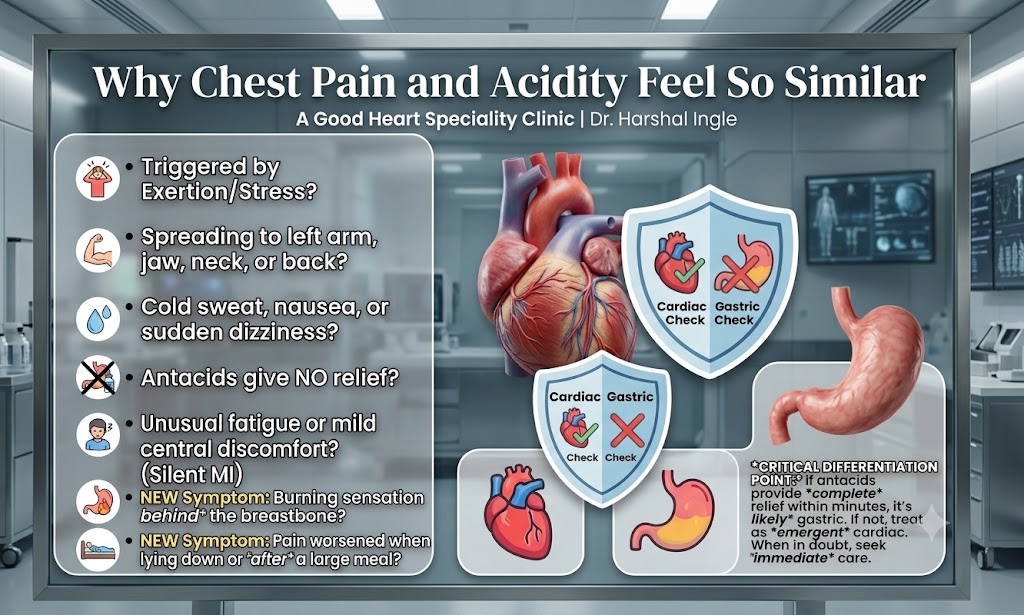
The heart and the oesophagus (food pipe) are surprisingly close to each other — they share the same nerve pathways. This is why a heart attack can feel like severe heartburn, and bad acid reflux can genuinely feel like a cardiac episode. Even experienced doctors sometimes need tests to tell them apart.
Both conditions can cause a burning or pressure-like sensation in the chest, both can worsen at night or when lying down, and both can be triggered by a large meal. The overlap is real — and it is dangerous.
Likely Acidity / GERD
No sweating, no arm pain, no breathlessness
Possible Cardiac Warning
Critical Rule: When in doubt, always treat it as cardiac first. If your chest discomfort does not completely resolve with an antacid within 20–30 minutes, or if you have any of the cardiac warning signs above — do not wait. Call emergency Pressure, squeezing, or heaviness in the chest
A silent heart attack — medically known as a Silent Myocardial Infarction (SMI) — is a heart attack that occurs with no obvious, classic symptoms. No dramatic chest clutching. No crushing pain. It may feel like mild indigestion, a pulled muscle, or nothing at all.
Studies suggest that nearly 45% of all heart attacks are silent. They are more common in people with diabetes (nerve damage can blunt the pain signal), women, and the elderly. The damage to the heart muscle is just as real and just as serious as a classic heart attack — the only difference is that it goes unrecognised and untreated, often for days or weeks.
By the time a silent heart attack is discovered — sometimes during a routine ECG test in Pune — the patient may already have significant heart muscle scarring, weakened pumping function, or irregular heart rhythm.
Symptoms that are often dismissed but may indicate a silent heart attack include: unusual fatigue lasting several days, mild discomfort in the centre of the chest, unexplained shortness of breath while doing routine tasks, a vague sense of “not feeling well” that doesn’t go away, and sudden cold sweats without obvious cause.
At Good Heart Clinic, Dr. Harshal Ingle has treated numerous patients who arrived days or weeks after their actual heart event — having assumed the symptoms were gastric. By the time they underwent an echocardiogram or coronary angiography, significant arterial damage was already present.
Delayed treatment means more heart muscle is lost. It means a higher likelihood of needing complex intervention — from high-risk angioplasty to bypass surgery (CABG) — rather than simpler, earlier treatment. It means a longer, harder recovery.
The single most important thing you can do for your heart health is to take symptoms seriously — and get evaluated.
When you walk into Good Heart Clinic with chest discomfort, Dr. Harshal Ingle’s team does not guess — they diagnose. A rapid cardiac evaluation typically includes:
— A 12-lead ECG (Electrocardiogram) to detect electrical abnormalities in the heart
— Blood tests for cardiac enzymes (Troponin), which rise when heart muscle is damaged
— An Echocardiogram to assess heart wall motion and pumping function
— A Cardiac CT Scan to visualise artery blockages non-invasively
— Cardiac Stress Testing if symptoms are exertion-related
This evidence-based workup takes the guesswork out of the equation — and gives you a clear, definitive answer within hours, not days.
| Cardiac Consultation with Dr. Harshal Ingle | ₹800 – ₹1,200 |
| ECG (Electrocardiogram) | ₹200 – ₹500 |
| Quick 10-min test · Results available immediately | |
| Echocardiogram (2D Echo) | ₹1,500 – ₹3,000 |
| Treadmill Test (TMT / Stress Test) | ₹1,500 – ₹2,500 |
| Cardiac CT Scan (Calcium Score) | ₹4,000 – ₹8,000 |
| Holter Monitoring (24–48 hr) | ₹2,000 – ₹4,000 |
| Cardiac Enzyme Blood Tests (Troponin etc.) | ₹800 – ₹2,000 |
| Complete Cardiac Workup Package | ₹6,000 – ₹15,000 |
| Most health insurance policies cover cardiac diagnostics · Cashless facility available at Ruby Hall Clinic | |
Yes, stress and anxiety can cause chest tightness and rapid heartbeat. But if the pain does not go away after relaxing, always get an ECG done to rule out any cardiac issue.
Do not wait. If chest pain lasts more than 5 minutes or comes with sweating or breathlessness, reach a cardiologist immediately. The first 60 minutes are the most critical for your heart.
Yes. Rising stress, smoking, obesity, and undetected diabetes are causing heart attacks in younger people. If you have a family history of heart disease, get a preventive check-up done today.
Yes. Women often feel unusual fatigue, nausea, jaw pain, or back pain instead of classic chest pain. These vague symptoms are easy to ignore — which is why women must take any persistent discomfort seriously.
A heart attack is a blocked artery — the heart keeps beating but is being damaged. Cardiac arrest is when the heart suddenly stops beating completely. Both are emergencies requiring immediate medical help.
If you are above 40 with no symptoms — once a year. If you have diabetes, high blood pressure, or family history of heart disease — start annual check-ups from age 25 onwards.
Good Heart Clinic — Best Cardiologist in Pune Morning OPD: Ruby Hall Clinic, Pune · Mon–Sat, 10 AM – 4 PM
Evening OPD: Dhole Patil Road, Pune · Mon–Sat, 4 PM – 8 PM
Appointment: 9822055445 / 8208950831
Cardiac Emergency (24×7): 9697020666 / 7722031119
drharshalingle@gmail.com
We believe that every patient deserves absolute confidence in their care plan.
303, A, Choice Apartments Opp Vohuman Cafe , Dhole Patil Road , Pune
Support mail: drharshalingle@gmail.com
Opening Hours: Mon -Sat: 04.00 PM to 08.00 PM