Welcome to meidicross the leading medical facility for the health of you and your family.
Welcome to meidicross the leading medical facility for the health of you and your family.


Last updated: 17 Sep 2026
Q: How long is recovery after coronary angioplasty?
A: Most patients go home the same day or next morning after angioplasty. Light activity resumes within 2–3 days. Desk work within 1–2 weeks. Driving after 1 week (radial access). Full normal activity by week 4–6. Complete cardiac recovery — including stent stabilisation — takes approximately 3 months.
Q: What Indian foods are safe to eat after angioplasty?
A: Safe Indian foods after angioplasty: dal, sabzi cooked in minimal oil, roti (1–2), brown rice, oats, poha, idli, curd (low-fat), fruits (banana, papaya, apple), and fish. Avoid: poori, paratha, ghee in excess, pickle, papad, fried snacks, and full-fat dairy for the first month.
Q: Can I stop my blood thinner tablet after angioplasty?
A: Never stop without doctor’s approval. Dual antiplatelet therapy (aspirin + clopidogrel/ticagrelor) must continue for a minimum of 6–12 months after a drug-eluting stent. Stopping early — even once — dramatically increases the risk of stent thrombosis, which can cause a fatal heart attack.
Q: When should I go to hospital after angioplasty?
A: Go immediately if your patient develops: new chest pain or tightness, sudden breathlessness at rest, dizziness or fainting, swelling or bleeding at the wrist site, fever above 38°C, or cold/numb hand on the procedure side. Do not wait — call the cardiac emergency number directly.
Q: When can a patient walk after angioplasty?
A: Same day — within 2–4 hours of a radial (wrist) angioplasty. Short, slow walks around the ward or home are encouraged from day one. By week 2, a 15–20 minute walk daily is the target. By week 4–6, 30-minute brisk walks are typically safe with cardiologist clearance.
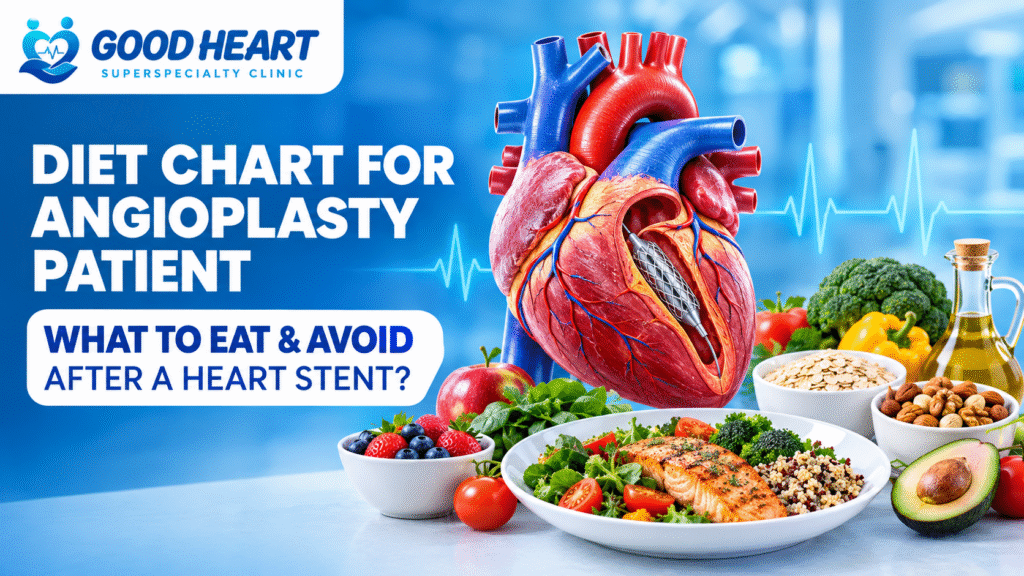
Getting a stent placed is a life-saving procedure, but it’s not a cure; it’s a fresh start. What you eat in the weeks and months after angioplasty plays a direct role in how well your artery heals, whether plaque continues to build up, and how soon you get back to a normal, active life. Many patients leave the hospital with a prescription but very little practical guidance on food. This often leads to confusion at the dinner table and, sometimes, a slow drift back into old habits.
This guide breaks down a simple, practical diet chart for angioplasty patient recovery, including a heart-healthy Indian diet after angioplasty, foods to eat, foods to avoid, and a ready-to-follow 7-day plan so you can protect your stent and your heart for the long run.
A stent opens up a blocked artery, but it doesn’t remove the underlying cause: cholesterol buildup, inflammation, and plaque formation. Left unmanaged, these can affect other parts of your coronary arteries or even the stented segment itself.
A well-planned diet after heart stent placement helps to:
In short, food is one of the most powerful tools you have to protect the results of your procedure.
Before getting into specific foods, it helps to understand the core rules that guide any heart-healthy diet after Coronary angioplasty:
Foods to eat after angioplasty: Here’s a closer look at what a good Indian diet after angioplasty should include.
Aim for at least 4–5 servings a day. Favour:
These are rich in potassium, antioxidants, and fibre, all of which support artery health.
Replace refined grains with whole, fibre-rich options:
Whole grains help regulate blood sugar and cholesterol levels far better than white rice or maida-based foods.
Choose lean, low-fat protein:
Fatty fish such as rohu or sardines, eaten twice a week, provide omega-3 fatty acids that support heart health.
Not all fat is bad. Include small amounts of:
The goal is moderation, not elimination; healthy fats support hormone balance and nutrient absorption.
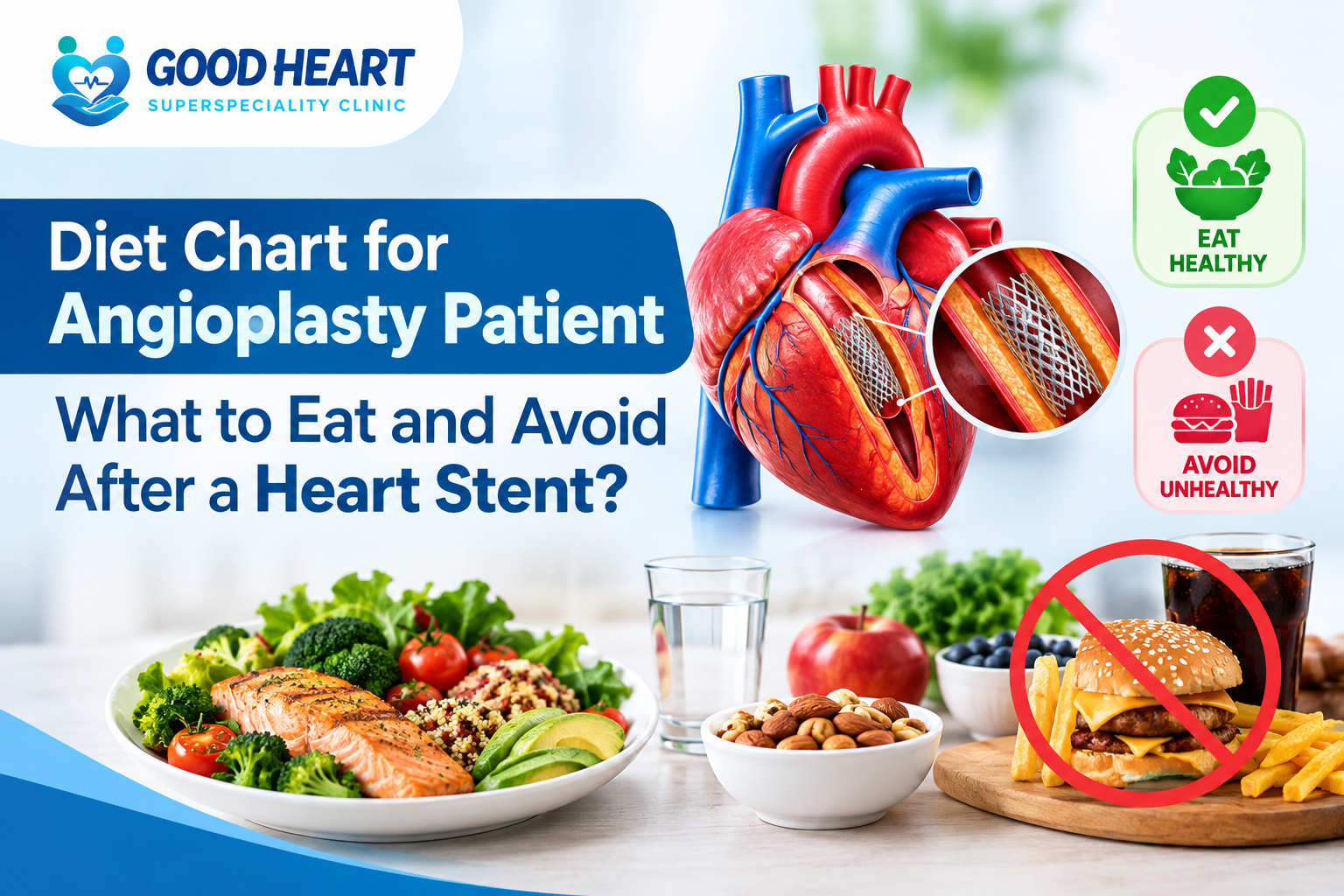
Just as important as what to eat is what to limit or cut out. Knowing exactly what to eat and avoid after a heart stent can make the difference between a smooth recovery and a repeat blockage. These foods to avoid after angioplasty are best kept to a minimum:
Even “healthy-sounding” packaged foods can be loaded with sodium or hydrogenated oils, so it’s worth checking labels carefully.
This 7-day diet plan after angioplasty gives you a simple framework you can adapt to your taste and doctor’s advice.
Day | Breakfast | Lunch | Dinner |
1 | Vegetable oats + boiled egg white | Roti, dal, lauki sabzi, salad | Grilled fish, steamed vegetables |
2 | Moong dal cheela + mint chutney | Brown rice, rajma, cucumber raita | Vegetable soup, multigrain roti |
3 | Poha with peas and vegetables | Roti, palak paneer (low-fat), salad | Grilled chicken, sautéed greens |
4 | Idli with sambar | Quinoa pulao, curd | Moong dal khichdi, salad |
5 | Vegetable upma | Roti, chana masala, salad | Baked fish, steamed broccoli |
6 | Fruit bowl with soaked almonds | Brown rice, mixed vegetable curry | Vegetable soup, roti |
7 | Besan chilla with chutney | Roti, dal, bhindi sabzi | Grilled paneer, sautéed spinach |
Keep portions moderate, drink 8–10 glasses of water daily, and space meals evenly through the day rather than eating large portions at once.
Diet alone isn’t enough; pair it with these habits:
Every patient’s recovery is different depending on the type of stent, overall heart function, and other conditions like diabetes or kidney disease. Always personalise your diet after angioplasty with your cardiologist or a clinical dietitian rather than following a generic chart alone, particularly if you have diabetes, chronic kidney disease, or are on specific blood-thinning medication that interacts with certain foods (such as vitamin K-rich greens with warfarin).
It should be low in saturated fat and sodium, high in fibre, and rich in fruits, vegetables, whole grains, and lean protein, tailored to your specific health conditions.
Start with light, easily digestible foods like khichdi, soups, and steamed vegetables for the first few days, then gradually move to a full heart-healthy diet.
Yes, but choose brown rice over white rice where possible, and keep portions moderate as part of a balanced meal.
This isn’t a short-term diet; it’s a long-term lifestyle shift that should continue for life to protect your heart and prevent future blockages.
Whole fruits are better than juices, since juicing removes fibre and often adds sugar. Eat fruit as-is whenever possible.
Moderate amounts (1–2 cups a day) are generally fine, but avoid adding excess sugar or cream, and check with your doctor if you have irregular heart rhythms.
This article has been medically reviewed for accuracy by Dr. Harshal Ingle, MD (MED), DrNB (Cardiology), Interventional Cardiologist at Good Heart Clinic, Pune, and recipient of the Excellence in Healthcare Award 2025 in Cardiology. Good Heart Clinic has performed 1,000+ complex cardiac interventions and treated 7,000+ patients over 10+ years, offering 24/7 emergency cardiac support.
This article is for general educational purposes and does not replace personalised medical advice. Please consult your cardiologist or a registered dietitian at Good Heart Clinic before making significant dietary changes after angioplasty.
Book your post-angioplasty follow-up consultation today. Your stent is doing its job. Make sure everything around it is too.
Morning OPD — Cardiac OPD C7, Ground Floor, Building 3, Ruby Hall Clinic, Pune 411001 Evening OPD — 303A, Choice Apartments, Opp. Vohuman Cafe, Dhole Patil Road, Pune 411001 Appointments: 9822055445 / 8208950831 Cardiac Emergency: 9697020666 / 7722031119 goodheartclinic.com
OPD Timings: Monday to Saturday | Morning: 10 AM – 4 PM | Evening: 4 PM – 8 PM
We believe that every patient deserves absolute confidence in their care plan.
303, A, Choice Apartments Opp Vohuman Cafe , Dhole Patil Road , Pune
Support mail: drharshalingle@gmail.com
Opening Hours: Mon -Sat: 04.00 PM to 08.00 PM