Welcome to meidicross the leading medical facility for the health of you and your family.
Welcome to meidicross the leading medical facility for the health of you and your family.


Last updated: June 26, 2026
Q: What is the purpose of a treadmill test in Pune?
A: A treadmill test (TMT) deliberately stresses the heart through progressive exercise to reveal coronary artery blockages that are completely invisible on a resting ECG. A 50% arterial blockage may show no abnormality at rest — but produces clear electrical changes during peak exertion that the TMT captures in real time.
Q: Can a treadmill test detect heart disease in young gym-goers?
A: Yes. Young adults — especially those with diabetes, family history, or high cholesterol — can develop significant coronary artery disease silently. Fatigue, breathlessness, or chest tightness during exercise that peers do not experience is a red flag requiring TMT evaluation, regardless of age or fitness level.
Q: Why does a top heart specialist in Pune monitor blood pressure during a TMT?
A: Blood pressure should rise progressively during exercise as cardiac output increases. A drop in BP during peak exercise — called exercise-induced hypotension — indicates severe coronary disease or left ventricular dysfunction. It is one of the most serious TMT findings and an immediate reason to stop the test and investigate further.
Q: Who should NOT take a treadmill test?
A: Absolute contraindications include: recent heart attack within 2–5 days, unstable angina, severe aortic stenosis, uncontrolled heart failure, symptomatic severe arrhythmia, and acute myocarditis. These patients require immediate stabilisation before any exercise test is considered — a top heart specialist assesses each case individually.
Q: How much does a treadmill test cost in Pune?
A: A treadmill test in Pune costs approximately ₹1,200 to ₹2,500 standalone. With a senior cardiologist consultation, the range is ₹1,800 to ₹3,500. Most corporate and individual health insurance policies cover TMT as a diagnostic investigation. No fasting required — wear comfortable shoes.
You are 34 years old. You run four times a week. You eat reasonably well and your last full-body checkup came back clean — ECG normal, blood pressure fine, cholesterol borderline but “nothing to worry about.”
But three months ago, something changed. The same 5-kilometre run that felt routine now leaves you more tired than it should. Your friends finish the group gym session and want to grab coffee. You want to sit down. Last Tuesday, you noticed a strange heaviness across your chest during the final sprint that faded quickly. You told yourself it was the heat.
It probably was. But a Treadmill Test in Pune is the test that finds out — definitively — whether your heart is as healthy as your resting ECG suggests, or whether it is carrying a hidden burden that only appears when you actually stress it.
The tragedy in young cardiac emergencies — and they are increasing in India’s urban, fitness-conscious professional population — is almost never a lack of warning. It is a lack of the right investigation at the right time. The warning was there. The test was not done.
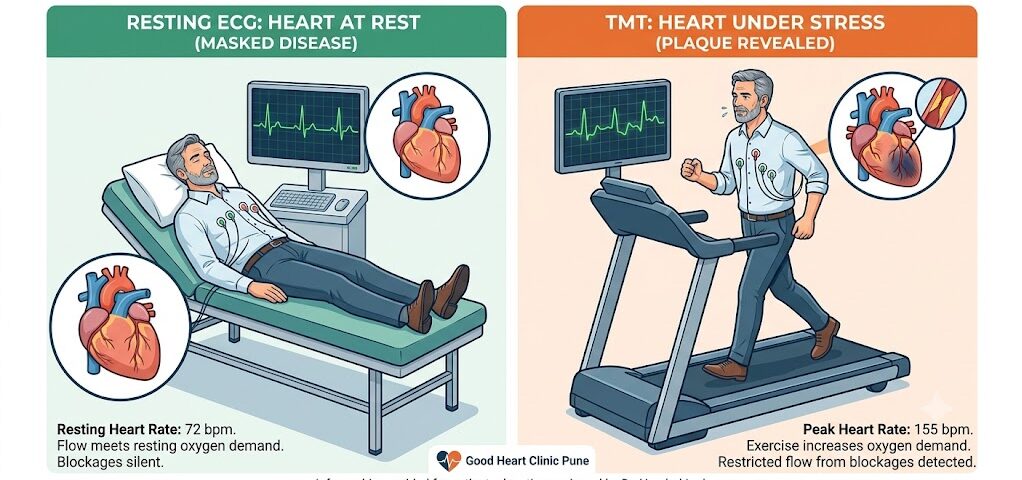
A Treadmill Test in Pune deliberately pushes the heart to its functional limit through progressive exercise — because coronary artery blockages that are completely silent at rest reveal themselves unmistakably when the heart’s oxygen demand exceeds what the narrowed artery can supply.
This is the central clinical logic of exercise stress testing, and it is worth understanding clearly.
At rest, your heart beats at 60–80 times per minute and requires a modest, stable blood supply from the coronary arteries. A coronary artery with a 50–60% blockage — significant disease that absolutely warrants treatment — can often meet this resting demand without strain. The blood squeezes through the narrowed channel just adequately enough to keep things running. Your resting ECG shows nothing alarming. Your symptoms are absent or vague.
This is not a clean bill of health. It is a resting state that masks a problem waiting for the right trigger.
As you step onto the treadmill and the speed and incline increase — following the standardised Bruce Protocol used globally — your heart rate rises, your cardiac output increases, and your coronary arteries must deliver substantially more oxygenated blood to the working heart muscle. By Stage 3 or Stage 4 of the Bruce Protocol, a fit adult’s heart may be demanding three to five times its resting blood supply.
A normal, healthy coronary artery dilates to meet this demand. A blocked artery cannot. The heart muscle supplied by that artery begins to experience ischaemia — oxygen deprivation — and this physiological stress produces measurable, specific changes:
ST-segment depression on ECG: The most classic TMT finding. The ST segment — the portion of the ECG waveform between ventricular contraction and repolarisation — shifts downward in a characteristic pattern when the underlying myocardium is oxygen-starved. One millimetre of horizontal or downsloping ST depression during exercise is a positive TMT result.
Exercise-induced chest symptoms: Chest tightness, pressure, or breathlessness that appears at a specific exercise intensity and resolves with rest is angina — the symptomatic expression of exercise-induced ischaemia. When symptoms and ECG changes occur together, the test result is unambiguous.
Chronotropic incompetence: The failure of the heart rate to rise appropriately with increasing exercise — reaching less than 85% of the age-predicted maximum heart rate. This finding indicates sinus node dysfunction and is a marker of both cardiac disease and poor prognosis.
Exercise-induced arrhythmias: Some patients develop ventricular ectopy, short runs of ventricular tachycardia, or significant supraventricular arrhythmias during peak exercise that are completely absent at rest. These findings require further electrophysiological evaluation.
According to the American Heart Association, the exercise stress test remains one of the most clinically valuable and cost-effective tools for detecting coronary artery disease — particularly in patients with exertional symptoms and intermediate pre-test probability of significant coronary disease.
For a thorough understanding of understanding exertional symptoms and hidden heart disease — including which symptom patterns during exercise are most predictive of underlying coronary artery disease — our patient education library provides clear, actionable information.
The association between fitness and cardiac health is real — but it is not absolute, and it is not unconditional. Urban Indian professionals in the 30–50 age group are carrying a specific and underappreciated risk burden:
TheTreadmill Test in Pune is the tool that bridges this gap — telling you what your fitness level feels like vs. what your coronary arteries actually look like under demand.
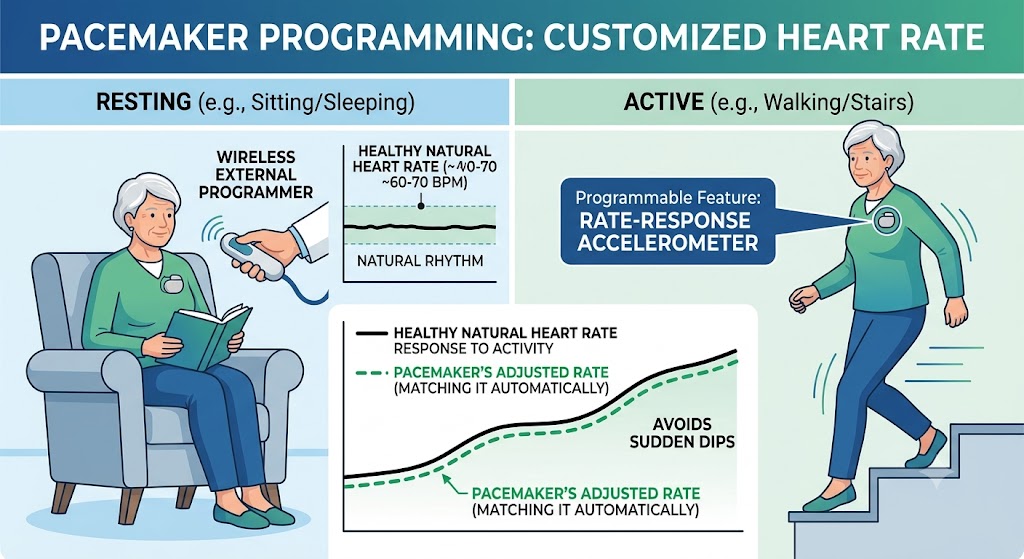
A top heart specialist in Pune monitors blood pressure and heart rate continuously during a TMT because these two parameters — not just the ECG — contain some of the most clinically significant and life-saving information the test generates.
The ECG is the headline of the TMT report. Blood pressure and heart rate response are the context — and in many cases, they are more urgent findings than the ECG changes themselves.
In a healthy cardiovascular system, cardiac output increases with exercise. Blood pressure — the product of cardiac output and vascular resistance — rises progressively as workload increases. A normal systolic blood pressure response is an increase of approximately 10 mmHg per metabolic equivalent (MET) of exercise, typically reaching 180–200 mmHg systolic at peak exertion in a hypertensive patient, and 160–180 mmHg in a normotensive individual.
Hypertensive response: A peak systolic blood pressure above 210 mmHg in men or 190 mmHg in women indicates an exaggerated hypertensive response — a risk factor for future hypertension development and increased cardiovascular events, even if resting blood pressure is normal. Many young professionals discover occult exercise-induced hypertension for the first time on a TMT.
Exercise-induced hypotension — the critical finding: A drop in systolic blood pressure of more than 10 mmHg from peak, or a failure of systolic BP to rise above the resting value during progressive exercise, is one of the most ominous findings in stress testing. It indicates either severe multi-vessel coronary artery disease causing global ischaemia that impairs left ventricular function, or significant left ventricular dysfunction. This finding prompts immediate test termination and urgent further investigation — typically coronary angiography.
Target heart rate: The maximum predicted heart rate is calculated as 220 minus the patient’s age. The TMT is designed to push the patient to at least 85% of this maximum — the threshold at which the test is considered diagnostically adequate. A 35-year-old patient should reach approximately 156 beats per minute during the test.
Failure to achieve target heart rate (chronotropic incompetence): When the heart rate fails to rise to 85% of predicted maximum despite maximal effort, this indicates dysfunction of the heart’s natural rate-response mechanism. It is associated with coronary artery disease, cardiac autonomic dysfunction, and significantly increased long-term mortality risk.
Heart rate recovery: How rapidly the heart rate drops in the first minute after exercise cessation is an independent predictor of cardiac mortality. A drop of less than 12 beats per minute in the first minute post-exercise — called abnormal heart rate recovery — has been shown in multiple studies to predict increased cardiovascular risk regardless of the ECG findings.
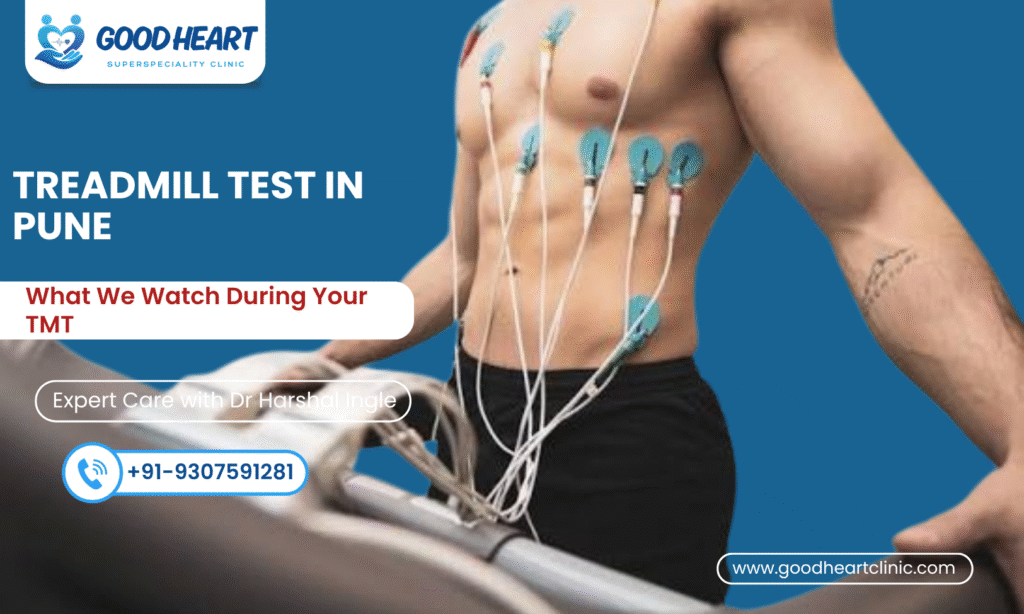
The top heart specialist in Pune supervising the TMT is simultaneously watching:
| Parameter | What Abnormal Looks Like | What It Suggests |
|---|---|---|
| ST segment | Depression ≥1mm horizontal/downsloping | Myocardial ischaemia |
| Systolic BP | Drop during exercise | Severe CAD / LV dysfunction |
| Systolic BP | Rise above 210/190 | Exercise hypertension |
| Heart rate | Fails to reach 85% max | Chronotropic incompetence |
| HR recovery | Drops <12 bpm in minute 1 | Autonomic dysfunction / high risk |
| Symptoms | Chest pain / breathlessness | Angina — correlate with ECG |
| Rhythm | Ventricular ectopy / VT | Arrhythmia risk |
This multi-parameter assessment is why TMT interpretation requires a cardiologist — not just a technician running the equipment. The value of the test is in the synthesis of all these signals, not any single data point in isolation.
Explore the range of advanced cardiac diagnostics at Good Heart Clinic — including how TMT findings integrate with intravascular imaging and coronary angiography for complex diagnostic pathways.
A Treadmill Test in Pune is safe and non-invasive for the vast majority of patients — but specific conditions make exercise testing actively dangerous, and a top heart specialist in Pune screens for these contraindications before any TMT begins.
The overall risk of a serious adverse event during a supervised TMT is extremely low — approximately 1 in 10,000 tests. This safety record exists precisely because experienced cardiologists perform careful pre-test screening and supervise every minute of the procedure with resuscitation equipment immediately available.
Recent acute myocardial infarction (within 2–5 days) In the days immediately following a heart attack, the myocardium is electrically unstable and vulnerable to life-threatening arrhythmias during exercise. A modified low-level TMT may be considered after 5–7 days in stable patients — but only under strict cardiologist supervision and in a hospital setting with full resuscitation capability.
Unstable angina not yet stabilised Unstable angina — chest pain that is new, rapidly worsening, or occurring at rest — represents an acutely vulnerable coronary plaque that may rupture during exercise-induced increases in heart rate and blood pressure. These patients need medical stabilisation and coronary angiography, not a stress test.
Severe symptomatic aortic stenosis A critically narrowed aortic valve limits the heart’s ability to increase cardiac output during exercise. Adding the demand of a TMT to this fixed obstruction can trigger acute syncope or ventricular fibrillation. Aortic valve assessment must precede any exercise testing.
Uncontrolled symptomatic heart failure When the heart is already failing to maintain adequate output at rest, exercise dramatically worsens the haemodynamic compromise. Active, decompensated heart failure — characterised by significant breathlessness at rest, severe leg oedema, or oxygen dependence — is an absolute contraindication to exercise testing.
Symptomatic severe cardiac arrhythmia Active ventricular tachycardia, high-degree heart block causing symptoms, or other haemodynamically significant arrhythmias must be evaluated and treated before exercise testing is considered. Exercise in the presence of these arrhythmias risks cardiac arrest.
Acute myocarditis or pericarditis Active inflammation of the heart muscle or surrounding pericardium makes the myocardium electrically vulnerable. Exercise in acute myocarditis is a known trigger for sudden cardiac death in young patients — a risk entirely preventable by deferring the TMT until inflammation has resolved.
These conditions do not absolutely prohibit a TMT, but require individual risk-benefit assessment by the cardiologist before proceeding:
The TMT is conducted under continuous cardiologist supervision precisely because adverse findings during the test require immediate termination. The test is stopped and the patient is moved to supine position when:
Early termination is not a failure of the test. It is a safety mechanism — and the findings at the point of termination are often the most diagnostically significant data the test produces.
A TMT is only as valuable as the cardiologist interpreting it. The equipment generates the data. The cardiologist synthesises it — distinguishing a true positive from a false positive, recognising the subtle finding that the automated analysis missed, deciding in real time whether the test needs to stop.
Dr. Harshal Ingle — MD (Medicine), DrNB Cardiology, Interventional Cardiologist at Ruby Hall Clinic, Pune — supervises every TMT with the same attention applied to complex interventional cases. His interventional background means he understands precisely what the TMT findings imply for downstream investigation — whether a borderline result warrants watchful waiting, a repeat test, or immediate coronary angiography.
Pre-test screening. Before you step on the treadmill, Dr. Ingle reviews your symptoms, risk factors, current medications, and resting ECG. Contraindications are assessed. The test is not started until it is confirmed safe to proceed.
Supervised throughout. The cardiologist is present — not in an adjacent room — for every stage of the Bruce Protocol. Blood pressure is measured at each stage. The ECG is continuously monitored and reviewed in real time. The test is stopped the moment any concerning finding appears.
Results explained immediately. When the test is complete, the report is reviewed with you during the same consultation. A positive result does not mean you leave with a printout and a phone number. It means Dr. Ingle explains what was found, what it implies, and what the next step is — whether that is reassurance, medication adjustment, or further investigation.
The complete diagnostic pathway under one roof. If the TMT is positive and coronary angiography is indicated, Good Heart Clinic offers the full spectrum — angiography, intravascular imaging (IVUS, OCT), and interventional treatment (angioplasty, Rotablation, Orbital Atherectomy) — at Ruby Hall Clinic without referral delays.
National recognition: Excellence in Healthcare Award 2025 in Cardiology | India Live 2024 Presenter | First in Pune — Orbital Atherectomy and Renal Denervation.
Clinic credentials:
| Service | Approximate Cost (INR) |
|---|---|
| Standalone Treadmill Test (TMT) | ₹1,200 – ₹2,500 |
| TMT with Cardiologist Consultation | ₹1,800 – ₹3,500 |
| TMT + Resting ECG + Echo Package | ₹4,500 – ₹8,000 |
| Stress Echocardiography (advanced) | ₹5,000 – ₹10,000 |
| Pre-test consultation only | ₹500 – ₹1,500 |
What influences cost:
Preparation for your TMT:
A treadmill test (TMT) is a cardiac stress test where you walk on a treadmill at increasing speed and incline while your ECG, heart rate, and blood pressure are monitored. It is done to detect coronary artery blockages that are invisible on a resting ECG — revealed by the oxygen demand of exercise.
Yes. Premature coronary artery disease is increasingly common in young South Asian adults — driven by genetic predisposition, diabetes, and metabolic risk. Fatigue, breathlessness, or chest tightness during exercise in a young person with risk factors warrants a TMT regardless of age or apparent fitness level.
No — and no. The TMT involves walking and running on a treadmill, which is physically demanding but not painful. It is performed under direct cardiologist supervision with resuscitation equipment immediately available. Serious complications occur in approximately 1 in 10,000 supervised tests — making it one of the safest diagnostic cardiac procedures available.
A positive TMT means the ECG showed ST-segment changes, blood pressure dropped during exercise, or significant symptoms occurred at a low workload — all suggesting coronary artery disease. A positive result does not mean you need surgery. It means the next step — typically coronary angiography to map the blockage — is indicated.
The active walking portion of the Bruce Protocol takes 8–15 minutes depending on fitness and how long you can sustain each stage. Including preparation, electrode placement, recovery monitoring, and results discussion, the total appointment is approximately 45–60 minutes.
Because a resting ECG captures the heart at minimal demand — when a partially blocked artery can still meet the body’s needs. A treadmill test stresses the heart to 85% of its maximum rate — the level at which a blocked artery cannot supply enough blood, producing the ECG changes, BP drop, or symptoms that reveal the problem.
Some medications — particularly beta-blockers — reduce heart rate response and can cause a false-negative TMT result by preventing the heart rate from reaching the target threshold. Your cardiologist will advise whether to continue, reduce, or temporarily stop specific medications before the test. Never stop medication without explicit cardiologist guidance.
Yes — if your blood pressure is reasonably controlled (below 180/110 mmHg on the day of the test). Uncontrolled hypertension above this level is a relative contraindication — the test may be deferred until better control is achieved. Your cardiologist will measure your blood pressure immediately before the test begins.
A standalone TMT in Pune costs approximately ₹1,200 to ₹2,500. With a senior cardiologist consultation, the range is ₹1,800 to ₹3,500. Combined TMT and echocardiography packages range from ₹4,500 to ₹8,000. Most corporate and individual health insurance plans cover TMT as a diagnostic investigation.
Dr. Harshal Ingle explains the specific finding immediately after the test — whether it is ST changes, a blood pressure response abnormality, an arrhythmia, or a combination. Based on the result, the next step is recommended: it may be intensified medical management, a repeat test after medication adjustment, or coronary angiography for definitive arterial mapping.
Exercise fatigue has dozens of explanations — dehydration, poor sleep, overtraining, anaemia, thyroid dysfunction. Most cases of workout fatigue are benign and require nothing more than lifestyle adjustment.
But some are not. And the ones that are not — the ones where a partially blocked coronary artery is quietly failing to keep up with your ambitions at the gym — do not announce themselves clearly. They feel like ordinary tiredness until they do not.
A Treadmill Test in Pune at Good Heart Clinic takes 45 minutes. It answers the question your resting ECG cannot. And if the answer is that something needs attention, you will know it in time to do something about it — which is exactly the position every cardiologist wants their patient to be in.
If you have been experiencing unusual fatigue during exercise, breathlessness disproportionate to your fitness level, or any chest discomfort that appears during physical activity — book your consultation with Dr. Harshal Ingle today.
Your heart is working hard for you. Give it 45 minutes of proper attention.
Morning OPD — Cardiac OPD C7, Ground Floor, Building 3, Ruby Hall Clinic, Pune 411001 Evening OPD — 303A, Choice Apartments, Opp. Vohuman Cafe, Dhole Patil Road, Pune 411001 Appointments: 9822055445 / 8208950831 Cardiac Emergency: 9697020666 / 7722031119
OPD Timings: Monday to Saturday | Morning: 10 AM – 4 PM | Evening: 4 PM – 8 PM
We believe that every patient deserves absolute confidence in their care plan.
303, A, Choice Apartments Opp Vohuman Cafe , Dhole Patil Road , Pune
Support mail: drharshalingle@gmail.com
Opening Hours: Mon -Sat: 04.00 PM to 08.00 PM