Welcome to meidicross the leading medical facility for the health of you and your family.
Welcome to meidicross the leading medical facility for the health of you and your family.

Last updated: June 09,2026
Your father has been feeling dizzy. Your mother faints without warning. The cardiologist has said the words — pacemaker implantation — and now you are sitting at home, phone in hand, searching for answers at midnight.
This blog is written for you.
Not for the cardiologist. Not for the patient. For the son or daughter who is trying to understand whether pacemaker implantation in Pune is safe for an elderly parent — what the procedure involves, what recovery looks like week by week, and how to choose a cardiologist who will treat your family member with the same care you would give them yourself.
Because that is the question competitors never answer. Let us answer it properly.

The heart beats because of electrical signals. Every heartbeat — roughly 60 to 100 times per minute at rest — is triggered by a tiny electrical impulse from a structure called the sinoatrial node. When this electrical system ages, gets damaged, or malfunctions, the heart beats too slowly (bradycardia), pauses unpredictably, or loses its rhythm entirely.
The result? Dizziness. Fainting. Extreme fatigue. Breathlessness during the simplest activities. In severe cases — sudden cardiac arrest.
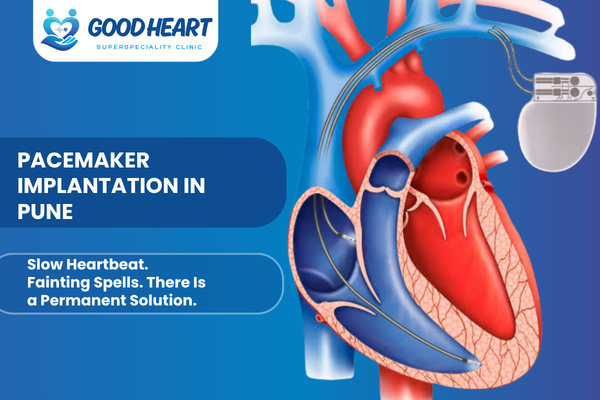
A pacemaker is a small, battery-powered device — roughly the size of a large coin — implanted just below the collarbone. It continuously monitors the heart’s electrical activity and sends a corrective impulse whenever the heartbeat drops below a set threshold. The heart is nudged back into rhythm, automatically, every time it needs it.
It does not replace the heart’s natural function. It supports it. And for elderly patients with conduction system disease, it is frequently the difference between a life spent in bed and a life spent at the dinner table with family.
For a deeper understanding of understanding heart rhythm problems in elderly patients — including when symptoms like dizziness and fainting warrant urgent investigation — our patient education library covers the full diagnostic pathway in plain language.
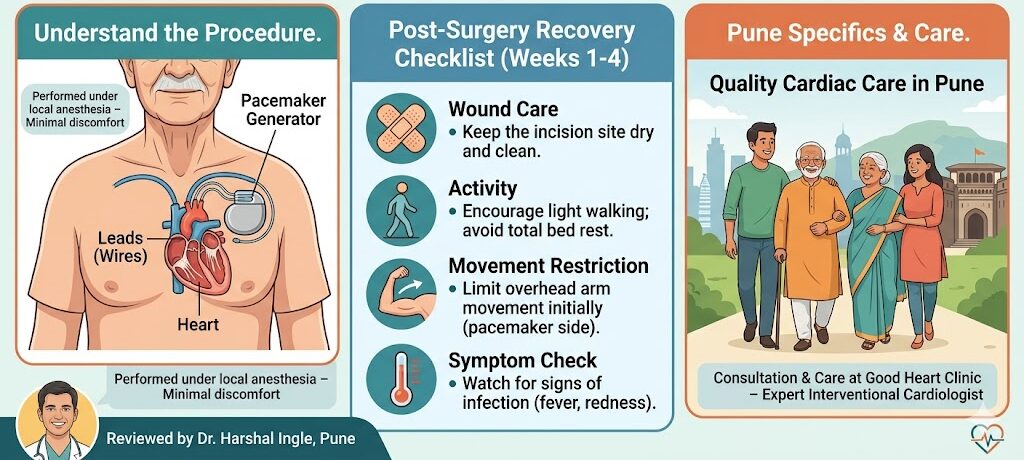
This is the section most families are too nervous to ask about — but it is the one that matters most. Here is exactly what happens, in plain terms.
Your parent will undergo a thorough pre-procedure workup: ECG, Holter monitor (24–48 hour heart rhythm recording), echocardiogram, blood tests, and a chest X-ray. The cardiologist will review all medications — blood thinners may be temporarily adjusted. Fasting is required from the night before.
The procedure is almost always performed under local anaesthesia with mild sedation — your parent is awake but relaxed and feels no pain. General anaesthesia is generally not required, which significantly reduces anaesthetic risk for elderly patients. This is one of the most important safety points caregivers miss.
A small incision — approximately 4–5 cm — is made just below the left collarbone. One or two thin, flexible leads (wires) are threaded through a vein into the heart chambers and anchored in place under X-ray guidance. The pacemaker generator is then connected to these leads and secured in a small pocket created beneath the skin.
The procedure takes approximately 45 minutes to 1.5 hours for a standard single or dual-chamber pacemaker. The patient feels pressure but no significant pain throughout.
The incision is closed with sutures or surgical glue. Your parent is moved to a monitored recovery ward. The pacemaker is tested and programmed before discharge. Most patients are discharged within 24–48 hours — sometimes the very next morning if recovery is smooth.
They go home with a Pacemaker ID Card containing device details, a clear list of activity restrictions, wound care instructions, and a follow-up appointment — typically within 1–2 weeks.
The arm on the pacemaker side must not be raised above shoulder height. No lifting, pulling, or reaching overhead. The wound site should be kept dry and clean. Mild soreness and swelling at the implant site is normal. Watch for signs of infection — redness, warmth, discharge, or fever — and report any of these immediately.
Light walking around the house is encouraged from day one or two. Short, slow walks are better than complete bed rest, which increases the risk of complications in elderly patients.
Most restrictions on arm movement ease progressively. By week 3–4, the shoulder can generally return to normal movement. Your parent can resume gentle daily activities — light cooking, slow walks outdoors, sitting with family. Driving is typically restricted for 4–6 weeks and until the cardiologist confirms the device is functioning well.
The majority of elderly patients feel a dramatic improvement in energy, dizziness, and breathlessness within the first month. The heart is now supported, oxygen delivery is restored, and the body responds. Many families report that their parent seems like a different person — more alert, more engaged, more present.
Cardiac follow-up at 1 month, 3 months, and then annually is standard. The pacemaker battery lasts 8 to 12 years in most modern devices. Battery replacement, when needed, is a minor procedure — the leads are usually reused, and only the generator is changed.
Modern pacemakers — particularly MRI-compatible (MRI-conditional) devices — have significantly reduced lifestyle restrictions compared to older generations. Your cardiologist will clarify exactly which activities are relevant to your parent’s specific device.
When it comes to an elderly parent, you are not just choosing a procedure. You are choosing a cardiologist who will make a high-stakes decision carefully, explain it completely, and remain available when questions arise at 9 PM.
Dr. Harshal Ingle — MD (Medicine), DrNB Cardiology, Interventional Cardiologist at Ruby Hall Clinic, Pune — brings over a decade of complex cardiac device experience to every pacemaker case. His patient profile skews significantly toward elderly patients with multiple comorbidities — diabetes, hypertension, kidney disease, prior heart attacks — patients where the margin for error is smallest and the need for clinical precision is highest.
Local anaesthesia as the standard. Dr. Ingle performs pacemaker implantations under local anaesthesia wherever clinically appropriate — avoiding the systemic risks of general anaesthesia that make families nervous about elderly patients undergoing cardiac procedures.
MRI-compatible device selection. Modern pacemakers implanted at Good Heart Clinic are selected with the patient’s full medical picture in mind — including their likelihood of needing an MRI scan in future years. This forward-thinking device selection is not universal across centres.
Family-included consultations. At Good Heart Clinic, you — the caregiver — are part of the consultation. Dr. Ingle speaks directly to family members, explains the procedure and recovery in terms that remove fear, and ensures that discharge instructions are understood, not just handed over on paper.
Pioneer-level technical expertise. Recognised as the pacemaker implantation treatment at Good Heart Clinic detail page outlines — Dr. Ingle has also performed the first Orbital Atherectomy and first Renal Denervation cases in Pune. He is a presenter at India Live 2024 and recipient of the Excellence in Healthcare Award 2025 in Cardiology, presented by Maharashtra’s Health Minister.
Clinic credentials:
According to the American Heart Association, pacemakers are safe, effective, and dramatically improve quality of life for patients with bradycardia and conduction system disorders — with outcomes in elderly patients that are consistently positive in experienced hands.
| Device / Procedure | Approximate Cost (INR) |
|---|---|
| Single-Chamber Pacemaker Implantation | ₹1,50,000 – ₹2,50,000 |
| Dual-Chamber Pacemaker Implantation | ₹2,50,000 – ₹4,00,000 |
| MRI-Compatible (MRI-Conditional) Pacemaker | ₹3,50,000 – ₹5,50,000 |
| Pacemaker Generator Replacement (battery change) | ₹1,00,000 – ₹2,00,000 |
| Pre-procedure workup (Holter + Echo + investigations) | ₹5,000 – ₹15,000 |
| Post-procedure follow-up + device check | ₹500 – ₹1,500 per visit |
What influences the cost:
Insurance: Pacemaker implantation is covered under most mediclaim policies, corporate health insurance, and government schemes including PMJAY (Ayushman Bharat). Our team assists with pre-authorisation documentation and claim support from the day of admission.
| Procedure | Approximate Cost (INR) |
|---|---|
| Coronary Angioplasty — Single Vessel (Bare Metal Stent) | ₹70,000 – ₹1,10,000 |
| Coronary Angioplasty — Single Vessel (Drug-Eluting Stent) | ₹1,20,000 – ₹2,00,000 |
| Multi-Vessel Angioplasty (2–3 vessels) | ₹2,00,000 – ₹4,00,000 |
| Orbital Atherectomy + Angioplasty (complex calcified lesion) | ₹2,50,000 – ₹4,50,000 |
| Post-procedure follow-up consultation | ₹500 – ₹1,500 |
| Cardiac Rehabilitation Programme (if enrolled) | ₹5,000 – ₹20,000 |
What drives the cost:
Insurance: Coronary angioplasty is covered under most mediclaim, corporate, and government health insurance schemes. Our team assists with documentation and pre-authorization to ensure a smooth claim process.
Yes — pacemaker implantation is one of the safest cardiac procedures for elderly patients. It is performed under local anaesthesia, avoiding the risks of general anaesthesia. Age alone is not a contraindication. Patients in their 80s and 90s routinely undergo successful pacemaker implantation with excellent outcomes and significant improvement in quality of life.
A standard single or dual-chamber pacemaker implantation takes approximately 45 minutes to 1.5 hours. The procedure is performed in a cardiac catheterisation laboratory under local anaesthesia and mild sedation, with continuous monitoring throughout.
Most patients are discharged within 24 to 48 hours after pacemaker implantation. The device is tested and programmed before discharge. A follow-up appointment is scheduled within 1–2 weeks for wound review and device interrogation.
Most patients do not feel the pacemaker once it is healed. Initially, there may be mild awareness of the device under the skin — a slight firmness below the collarbone. This typically fades within a few weeks. The pacemaker itself is silent and generates no sensation during normal operation.
Modern pacemaker batteries last 8 to 12 years depending on how frequently the device is pacing and the specific model. When the battery nears depletion, only the generator (the device body) is replaced — the leads implanted in the heart are typically reused. Generator replacement is a minor procedure, simpler than the original implantation.
Single-chamber pacemaker implantation in Pune costs approximately ₹1,50,000 to ₹2,50,000. Dual-chamber devices range from ₹2,50,000 to ₹4,00,000. MRI-compatible pacemakers cost more due to device technology. Most health insurance policies cover pacemaker implantation — our team assists with pre-authorisation.
Yes. Modern pacemakers are shielded against interference from standard consumer electronics including mobile phones. The general guidance is to keep the phone on the opposite side from the pacemaker and avoid placing it directly over the device for extended periods. Normal use — calls, texting, browsing — is safe.
For the first 4–6 weeks, the arm on the pacemaker side should avoid overhead movements, heavy lifting, and strenuous activity. After healing is confirmed, most normal daily activities — walking, cooking, travelling — resume fully. Specific restrictions depend on the patient’s underlying condition and device type, which Dr. Ingle discusses in detail at discharge.
Warning signs include return of dizziness or fainting, unusual breathlessness, persistent hiccups (a rare sign of lead displacement), swelling or redness at the implant site, or the pacemaker site feeling unusually hot. Any of these warrant immediate contact with your cardiologist or an emergency visit.
Yes. Pacemaker implantation is covered under most mediclaim, corporate, and government health insurance policies including Ayushman Bharat (PMJAY). Coverage includes the device cost, procedure, and hospitalisation. Pre-authorisation is typically required — the Good Heart Clinic team handles this documentation proactively to prevent delays.
Watching a parent struggle with dizziness, fatigue, or unexplained fainting is frightening. And when a cardiologist recommends a pacemaker, the fear doubles — not because the procedure is dangerous, but because the unknown always feels dangerous.
Pacemaker implantation in Pune, performed by an experienced interventional cardiologist under local anaesthesia, is one of the most reliably safe and life-improving cardiac procedures available. The recovery is measured in weeks, not months. The improvement is often visible within days.
Your parent deserves a cardiologist who will explain this patiently — to them, and to you.
Dr. Harshal Ingle and the team at Good Heart Clinic are ready for that conversation.
Book a consultation today. Bring your questions. Bring the family. We will take it from there.
Morning OPD — Cardiac OPD C7, Ground Floor, Building 3, Ruby Hall Clinic, Pune 411001 Evening OPD — 303A, Choice Apartments, Opp. Vohuman Cafe, Dhole Patil Road, Pune 411001 Appointments: 9822055445 / 8208950831 Cardiac Emergency: 9697020666 / 7722031119
OPD Timings: Monday to Saturday | Morning: 10 AM – 4 PM | Evening: 4 PM – 8 PM
This content is for caregiver and patient education only. It does not replace a personalised medical consultation. Please consult Dr. Harshal Ingle or a qualified cardiologist for advice specific to your family member’s condition.
We believe that every patient deserves absolute confidence in their care plan.
303, A, Choice Apartments Opp Vohuman Cafe , Dhole Patil Road , Pune
Support mail: drharshalingle@gmail.com
Opening Hours: Mon -Sat: 04.00 PM to 08.00 PM