Welcome to meidicross the leading medical facility for the health of you and your family.
Welcome to meidicross the leading medical facility for the health of you and your family.


Last updated: June 06,2026
Stent lag gaya. Ab kya?
For most patients, this is the question no one fully answers. The procedure is done. The family exhales. The cardiologist says it went well. And then you are handed a discharge summary, a bag of medications, and sent home — often without a clear picture of what life actually looks like from here.
This blog is that picture.
Coronary angioplasty in Pune has become one of the most commonly performed cardiac interventions — and when done right, with the right follow-up, it genuinely gives patients their lives back. Active lives. Full lives. Lives where climbing stairs, playing with grandchildren, and taking morning walks are not memories of the past but the present reality.
But a stent is not a cure. It is a fresh start. And what you do after the procedure determines everything.
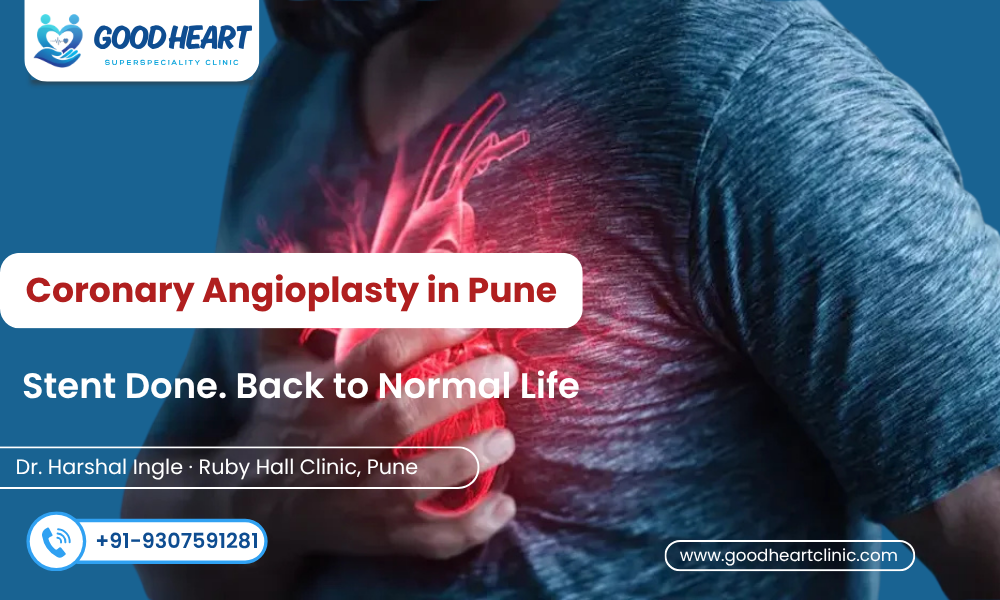
Coronary angioplasty, also called Percutaneous Coronary Intervention (PCI), is a minimally invasive procedure that opens narrowed or blocked coronary arteries — the vessels that supply blood directly to the heart muscle. When a blockage reduces blood flow, the heart muscle is starved of oxygen. The result: chest pain (angina), breathlessness, a heart attack, or in severe cases, sudden cardiac failure.
During angioplasty, a cardiologist threads a thin catheter — typically through the wrist (radial approach) — to the site of the blockage. A tiny balloon at the tip is inflated to compress the plaque against the artery wall, widening the vessel. A stent — a small mesh tube, usually a drug-eluting stent (DES) — is then deployed to hold the artery open permanently.
The blocked artery that was choking your heart muscle now flows freely. Oxygen returns. The pain resolves. The heart begins to heal.
According to the American Heart Association, coronary angioplasty with stenting is the most effective and widely used treatment for obstructive coronary artery disease, with high procedural success rates in experienced interventional centres.
The stent type recommended for you depends on your artery size, blockage length, vessel complexity, and overall health profile — all assessed and explained by your cardiologist before the procedure.
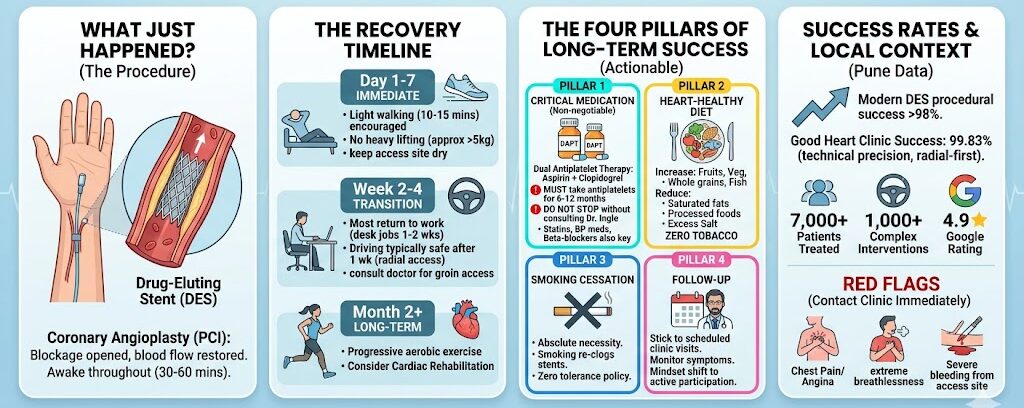
Understanding the procedure removes the fear around it. Here is exactly what happens:
Blood thinners (antiplatelets) are started — typically aspirin and clopidogrel — to prevent clot formation at the stent site. You will fast for a few hours beforehand. The wrist (or occasionally the groin) is cleaned and anaesthetised.
The catheter is guided to the coronary artery under real-time X-ray guidance. The balloon is inflated at the blockage site. The stent is deployed and expanded. The entire intervention for a single vessel typically takes 30–60 minutes. You are awake throughout, mildly sedated, and feel no pain — the arteries have no pain receptors.
A compression band is placed over the wrist access site. You are monitored for 4–6 hours. In most straightforward cases, discharge happens the same day or the following morning. You go home with medications, a follow-up date, and — critically — a clear plan for the weeks ahead.
For a detailed guide on maintaining a heart-healthy lifestyle after a cardiac procedure, our patient resource library has step-by-step guidance tailored for post-angioplasty recovery.
This is the section most cardiology websites skip. Let us be specific.
Rest is important but not total bed rest. Light walking — 10 to 15 minutes, twice a day — is actively encouraged from day two or three. Avoid lifting heavy objects. Keep the wrist site dry and clean. Watch for any unusual swelling, redness, or chest discomfort and report it immediately.
Most patients with desk jobs return to work within 1–2 weeks. Physical activity gradually increases — brisk walking, light household activity. Driving is typically permitted after 1 week for radial-access procedures (groin access requires longer). Sexual activity can generally resume after 1–2 weeks if the patient is otherwise feeling well.
Cardiac rehabilitation — structured exercise under medical supervision — significantly improves long-term outcomes after angioplasty. Not all patients are formally enrolled, but the principles apply to everyone: progressive aerobic exercise, dietary changes, stress management, and smoking cessation.
The single most important factor in long-term stent success is dual antiplatelet therapy (DAPT) — aspirin + a second antiplatelet (clopidogrel, ticagrelor, or prasugrel). This combination must be continued for a minimum of 6–12 months after drug-eluting stent placement. Stopping early — even once — dramatically increases the risk of stent thrombosis, which can cause a sudden, severe heart attack.
Beyond antiplatelets: statins (cholesterol), ACE inhibitors or ARBs (blood pressure), and beta-blockers (heart rate and remodelling) form the core post-angioplasty medication regimen. These are not optional additions. They are the evidence base.
A stent opens the artery. Diet is what keeps it healthy.
Coronary angioplasty with modern drug-eluting stents has procedural success rates exceeding 95–98% in experienced interventional centres. At Good Heart Clinic, our procedural success rate is 99.83% — a figure that reflects both technical precision and the rigorous patient selection that goes into every intervention.
Long-term outcomes depend on:
Patients who adhere to medications, adopt heart-healthy lifestyles, and maintain regular follow-up have outcomes that are genuinely comparable to people who never had a blockage. That is not marketing language — it is what the clinical evidence shows.
Understanding recognising early warning signs of heart disease is equally important after a stent — so that any change in symptoms is caught and addressed early, before it becomes a setback.
Dr. Harshal Ingle — MD (Medicine), DrNB Cardiology, Interventional Cardiologist at Ruby Hall Clinic, Pune — has performed over 1,000 complex cardiac interventions, including angioplasties involving heavily calcified vessels, bifurcation lesions, and multi-vessel disease that other centres classify as technically challenging.
Radial-first, always. Every eligible angioplasty patient at Good Heart Clinic undergoes the procedure through the wrist. Less bleeding. Faster recovery. Same-day discharge in straightforward cases. This is not a convenience — it is a clinical commitment backed by global evidence.
Pioneer-level capability for complex cases. Dr. Ingle is the first cardiologist in Pune to perform Orbital Atherectomy — a technique that clears severely calcified blockages that standard balloons cannot cross. Patients referred elsewhere as “too complex” are routinely treated here with excellent outcomes.
Post-procedure follow-up that is actually structured. Your discharge is not the end of our involvement. Follow-up appointments, medication reviews, and lifestyle counselling are built into the care pathway — because the stent procedure is only the beginning.
Nationally recognized expertise. Recipient of the Excellence in Healthcare Award 2025 in Cardiology, presented by Maharashtra’s Health Minister. Presenter at India Live 2024 — India’s premier interventional cardiology conference.
Clinic numbers:
| Procedure | Approximate Cost (INR) |
|---|---|
| Coronary Angioplasty — Single Vessel (Bare Metal Stent) | ₹70,000 – ₹1,10,000 |
| Coronary Angioplasty — Single Vessel (Drug-Eluting Stent) | ₹1,20,000 – ₹2,00,000 |
| Multi-Vessel Angioplasty (2–3 vessels) | ₹2,00,000 – ₹4,00,000 |
| Orbital Atherectomy + Angioplasty (complex calcified lesion) | ₹2,50,000 – ₹4,50,000 |
| Post-procedure follow-up consultation | ₹500 – ₹1,500 |
| Cardiac Rehabilitation Programme (if enrolled) | ₹5,000 – ₹20,000 |
What drives the cost:
Insurance: Coronary angioplasty is covered under most mediclaim, corporate, and government health insurance schemes. Our team assists with documentation and pre-authorization to ensure a smooth claim process.
Coronary angioplasty is a minimally invasive procedure where a blocked coronary artery is opened using a balloon catheter and held open with a stent. It restores normal blood flow to the heart muscle without open-heart surgery, and is typically performed through the wrist under local anaesthesia.
A modern drug-eluting stent is permanent — it does not expire or degrade. With proper medications and lifestyle changes, a stent can provide durable, long-term relief from angina and reduced risk of heart attack for years to decades. The key variable is adherence to antiplatelet therapy and risk factor management.
Yes — absolutely. The majority of patients return to full, active lives within 2–4 weeks of the procedure. Walking, working, travelling, and normal physical activity are all achievable. Many patients report feeling better than they have in years once the blocked artery is opened and medications are optimised.
Stopping antiplatelet medications (aspirin + clopidogrel) prematurely is one of the most dangerous decisions a post-angioplasty patient can make. It sharply increases the risk of stent thrombosis — a sudden clot forming inside the stent — which can cause a major, life-threatening heart attack. Never stop these medications without your cardiologist’s direct guidance.
Procedural success rates for coronary angioplasty with drug-eluting stents exceed 95–98% nationally in experienced centres. At Good Heart Clinic, the procedural success rate is 99.83%. Long-term success depends significantly on medication adherence and lifestyle modifications post-procedure.
The procedure itself is not painful. It is performed under local anaesthesia at the wrist access site, and patients are mildly sedated throughout. You may feel mild pressure or a brief warm sensation when the contrast dye is injected — that is all. Most patients are surprised by how comfortable the experience is.
Most patients are discharged the same day or the following morning. Light activity resumes within 2–3 days. Desk work is possible within 1–2 weeks. Strenuous physical activity and heavy lifting should be avoided for 4–6 weeks. Full functional recovery for most patients happens within 4–8 weeks.
Yes — this is called in-stent restenosis, where scar tissue gradually narrows the stent opening. Drug-eluting stents dramatically reduce this risk to under 5–10% at one year, compared to 20–30% with older bare-metal stents. If restenosis does occur, it is treatable — typically with repeat balloon dilation or a new stent.
Single-vessel angioplasty with a drug-eluting stent in Pune costs approximately ₹1,20,000 to ₹2,00,000. Multi-vessel procedures range from ₹2,00,000 to ₹4,00,000. Most health insurance policies — including corporate and government schemes — cover these procedures. Pre-authorisation support is provided at Good Heart Clinic.
Not always. Angioplasty is appropriate for most single and double vessel blockages, and many triple vessel cases. Bypass surgery is typically recommended for severe left main artery disease, certain complex triple vessel patterns, or when angioplasty is technically not feasible. Dr. Harshal Ingle discusses every case individually — no patient is steered toward surgery without a thorough evaluation of all alternatives.
The patients who do best after coronary angioplasty are not the ones with the least severe blockages. They are the ones who commit to what comes after — the medications, the walks, the diet changes, the follow-ups, the mindset shift from patient to participant in their own heart health.
If you or someone you love has recently undergone coronary angioplasty in Pune — or is facing the prospect of one — know this: with the right cardiologist, the right approach, and the right commitment after the procedure, a full and active life is not just possible. It is the expectation.
Dr. Harshal Ingle and the team at Good Heart Clinic are here to make that expectation your reality.
Book your post-angioplasty consultation or pre-procedure assessment today.
Morning OPD — Cardiac OPD C7, Ground Floor, Building 3, Ruby Hall Clinic, Pune 411001 Evening OPD — 303A, Choice Apartments, Opp. Vohuman Cafe, Dhole Patil Road, Pune 411001 Appointments: 9822055445 / 8208950831 Cardiac Emergency: 9697020666 / 7722031119 goodheartclinic.com
OPD Timings: Monday to Saturday | Morning: 10 AM – 4 PM | Evening: 4 PM – 8 PM
This content is for patient education only. It does not replace personalised medical advice. Please consult Dr. Harshal Ingle or a qualified cardiologist for guidance specific to your condition and treatment history.
We believe that every patient deserves absolute confidence in their care plan.
303, A, Choice Apartments Opp Vohuman Cafe , Dhole Patil Road , Pune
Support mail: drharshalingle@gmail.com
Opening Hours: Mon -Sat: 04.00 PM to 08.00 PM