Welcome to meidicross the leading medical facility for the health of you and your family.
Welcome to meidicross the leading medical facility for the health of you and your family.


Last updated: May 24,2026
Coronary angioplasty in Pune is one of the most performed life-saving heart procedures today — and yet, most patients walk into the procedure knowing very little about it. They hear the word “stent,” they sign the consent form, and they trust the system. But there is one critical question that deserves more attention than it gets: Are all heart stents the same?
The answer is no. And that difference could shape your recovery, your long-term heart health, and ultimately your life.
At Good Heart Clinic, we believe an informed patient is a safer patient. This blog will walk you through exactly what coronary angioplasty is, how the procedure is performed, why stent quality matters more than most people realise, and how to understand the real cost of coronary angioplasty in Pune — beyond just the number on the invoice.
Coronary angioplasty — also called Percutaneous Coronary Intervention (PCI) — is a minimally invasive procedure used to open blocked or narrowed coronary arteries. These arteries supply blood to the heart muscle. When they become blocked by fatty deposits (plaque), the heart is starved of oxygen, leading to chest pain (angina) or a heart attack.
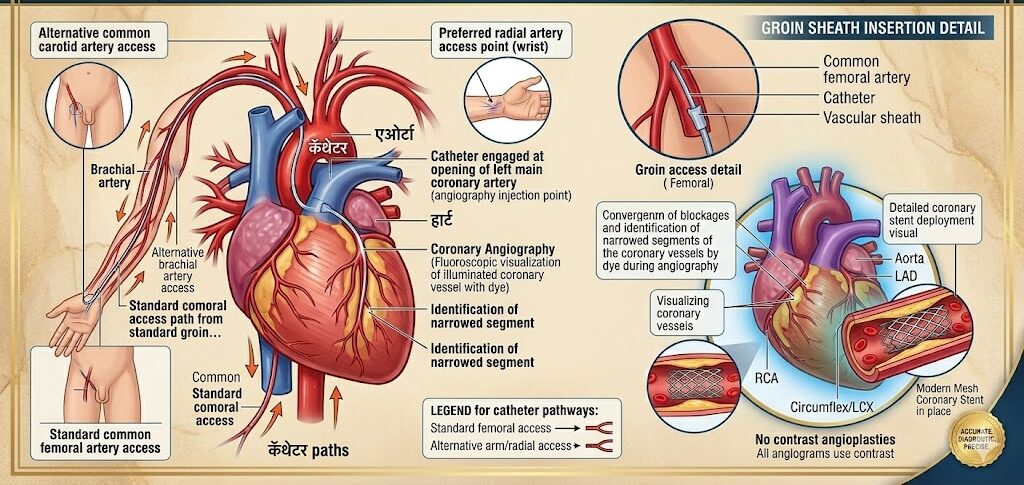
During coronary angioplasty in Pune, a cardiologist inserts a thin, flexible tube called a catheter through an artery in the wrist or groin. A tiny balloon at the tip is inflated at the site of the blockage to widen the artery. In most cases, a small metal mesh tube called a stent is then placed permanently to keep the artery open.
The procedure typically takes 30 to 90 minutes, requires no open surgery, and most patients are discharged within 24–48 hours. It can be life-saving when performed during a heart attack and significantly improves quality of life for patients with severe angina.
Also read: Angioplasty Explained: Procedure, Recovery and Risks — a detailed guide for patients and families.
Understanding the treatment process helps reduce anxiety and improves cooperation during recovery.
Step 1 — Pre-Procedure Assessment Before recommending coronary angioplasty, your cardiologist will review your symptoms, ECG, echocardiogram, and often perform a coronary angiography to map the location and severity of blockages. This diagnostic step is crucial and must not be skipped.
Step 2 — Preparation You will be asked to fast for a few hours before the procedure. Blood thinners and other medications may be adjusted. Local anaesthesia is given at the catheter insertion point — most patients are awake throughout.
Step 3 — Catheter Insertion A small nick is made at the wrist (radial access) or groin (femoral access). The catheter is gently threaded through the blood vessel toward the heart using real-time X-ray imaging called fluoroscopy.
Step 4 — Balloon Inflation and Stent Deployment Once the blocked artery is reached, the balloon is inflated to compress the plaque against the artery walls. The stent is then expanded and left in place as a permanent scaffold, keeping the artery open.
Step 5 — Recovery and Monitoring After the procedure, you are moved to a recovery area or ICU for monitoring. Vital signs, heart rhythm, and the insertion site are closely observed. Most patients are mobile within hours.
Step 6 — Discharge and Follow-Up Patients are typically discharged the next day with a prescription for blood thinners (dual antiplatelet therapy) to prevent clot formation around the stent. Follow-up visits are scheduled at 1 month, 3 months, and 6 months post-procedure.
When a family member has a heart blockage, the first question most people ask is “How much does it cost?” But the question that matters far more is: “What kind of stent are you using?”
Not all heart stents are equal. Here is what you need to know.
Bare metal stents are plain metal scaffolds. They are cheaper — often significantly so — but they carry a higher risk of restenosis, meaning the artery can re-narrow inside the stent within 6–12 months as scar tissue builds up. Studies show restenosis rates with bare metal stents can be as high as 20–30%.
For younger patients or those with certain complex anatomy, this means the procedure may need to be repeated — adding cost, risk, and emotional stress that completely undermines the initial saving.
Drug-eluting stents are coated with a medication that is slowly released into the artery wall after placement. This drug actively prevents the growth of scar tissue and dramatically reduces restenosis rates — typically to below 5%.
Modern drug-eluting stents also use advanced polymer technologies or polymer-free designs that make them better tolerated by the body. Some of the latest generation stents are biodegradable — meaning the polymer coating dissolves over time, leaving only the metal scaffold, which further reduces the risk of late complications.
A cheaper stent may save you ₹30,000–₹50,000 today. But if it leads to restenosis requiring a repeat procedure, you are looking at double the cost, double the risk, and a delayed recovery. At Good Heart Clinic, Dr. Harshal Ingle and Dr. Rahoul Nagdda discuss stent selection transparently with every patient, ensuring that the choice of device is driven by clinical need — not cost-cutting.
Related reading: Angioplasty Cost in Pune: Stent Price & Charges Explained — understand exactly what you are paying for.
One of the most common questions patients search for is the cost of coronary angioplasty in Pune. The honest answer is: it depends — but here is how to think about it clearly.
| Cost Component | What It Covers |
|---|---|
| Cath Lab Charges | Use of the specialised cardiac catheterisation laboratory |
| Cardiologist’s Fee | Professional fee for the interventional cardiologist |
| Stent Cost | The single biggest variable — type and number of stents |
| ICU / Monitoring | Post-procedure observation and nursing care |
| Hospital Stay | Bed charges for 1–2 days (typical) |
| Medications | Blood thinners and other drugs during admission |
| Consumables | Catheters, balloons, guide wires, contrast dye |
Note: These are indicative ranges. Actual pricing depends on stent brand, hospital facility level, and individual patient complexity. Always ask for a written cost estimate before the procedure.
Yes, in most cases — but details matter. Check your policy for:
At Good Heart Clinic, our team helps patients navigate insurance pre-authorization and paperwork so there are no unpleasant billing surprises after discharge.
This is the conversation we wish every patient had before their procedure.
| Factor | Cheap / Basic Stent | Premium Drug-Eluting Stent |
|---|---|---|
| Restenosis Risk | 20–30% | Less than 5% |
| Repeat Procedure Risk | Higher | Significantly lower |
| Long-term medication duration | Shorter | Longer (dual antiplatelet) |
| Polymer technology | Older / absent | Advanced / biodegradable |
| Recommended for complex cases | No | Yes |
| Long-term cost efficiency | Lower upfront, higher lifetime | Higher upfront, lower lifetime |
The math is straightforward. A premium stent is an investment in durability. For patients with diabetes, small vessels, long blockages, or multiple stents required — the case for a drug-eluting stent is even stronger.
We are not saying cheap stents are never appropriate. In select cases and specific patient profiles, they may be a valid option. But that decision should be made clinically — with full information shared with the patient. Not made quietly, in a hospital where the focus is on cutting costs.
Coronary angioplasty in Pune is available at many hospitals. So why do patients repeatedly choose Good Heart Clinic? The answer lies in three things: expertise, transparency, and genuine patient-first care.
Dr. Harshal Ingle is a highly trained interventional cardiologist with expertise in high-risk and complex coronary angioplasty. He performs procedures using intravascular imaging tools like IVUS and OCT — technologies that allow real-time visualisation inside the artery for more precise stent placement. Dr. Ingle believes in educating every patient about their condition, the procedure, and the stent being used — before, during, and after care.
Dr. Rahoul Nagdda brings deep expertise in cardiac care and interventional procedures, working alongside Dr. Ingle to provide comprehensive heart care across complex cases.
It is a procedure where a blocked heart artery is opened using a balloon catheter and kept open with a metal stent — without open-heart surgery.
No. It is a minimally invasive procedure done through a small puncture in the wrist or groin. Most patients go home within 24–48 hours.
With modern techniques and drug-eluting stents, success rates exceed 95% in experienced hands. Complications are rare when the procedure is performed at a well-equipped centre.
A cheap (bare metal) stent provides structural support but does not prevent scar tissue regrowth. A medicated (drug-eluting) stent releases medication that actively prevents re-blockage, reducing the risk of repeat procedure to under 5%.
Stents are permanent implants. A well-placed drug-eluting stent in a well-managed patient can remain effective for decades. Regular follow-up and medication adherence are essential.
Yes. Most patients return to regular activities within 1–2 weeks. Lifestyle changes — healthy diet, regular exercise, no smoking — are important for long-term success.
Generally yes, but coverage details vary. Drug-eluting stent costs may have capping under some policies. Always verify with your insurer before the procedure.
A single vessel angioplasty with a drug-eluting stent typically ranges from ₹1,20,000 to ₹2,00,000 depending on the stent used and hospital facility. Contact Good Heart Clinic for a personalised estimate.
Your cardiologist will recommend a coronary angiography first to map blockages. Based on the location, severity, and number of blockages, they will determine whether angioplasty, medication, or bypass surgery is most appropriate.
Intravascular imaging (IVUS or OCT) allows the cardiologist to see inside the artery in real time — ensuring the stent is correctly sized, fully expanded, and properly positioned. It significantly improves outcomes, especially in complex cases.
If you or a loved one has been advised coronary angioplasty, do not make this decision without a thorough, expert consultation. Understanding your stent options, your cost breakdown, and your long-term care plan is your right as a patient.
Dr. Harshal Ingle and Dr. Rahoul Nagdda at Good Heart Clinic are available for consultation at:
For Appointment: +91-9822055445 / +91-8208950831 Emergency: +91-9697020666 / +91-7722031119
We believe that every patient deserves absolute confidence in their care plan.
303, A, Choice Apartments Opp Vohuman Cafe , Dhole Patil Road , Pune
Support mail: drharshalingle@gmail.com
Opening Hours: Mon -Sat: 04.00 PM to 08.00 PM