Welcome to meidicross the leading medical facility for the health of you and your family.
Welcome to meidicross the leading medical facility for the health of you and your family.


Last updated: May 20,2026
Your doctor just said three words that stopped you cold — “You need angiography.”
Before you could process it, your mind went to work. Is it dangerous? Will the dye harm my kidneys? What if something goes wrong on the table? What if the procedure itself triggers a heart attack?
These fears are real. They are also, in most cases, based on myths that have been passed around by well-meaning family members, outdated internet articles, and neighbours who heard something from someone who had it done fifteen years ago.
At Good Heart Clinic, Pune, we have one firm belief — a patient who understands their procedure is a patient who heals better. So today, Dr. Harshal Ingle — one of the most experienced interventional cardiologists performing Coronary Angiography Treatment Pune is going to set the record straight, one myth at a time.
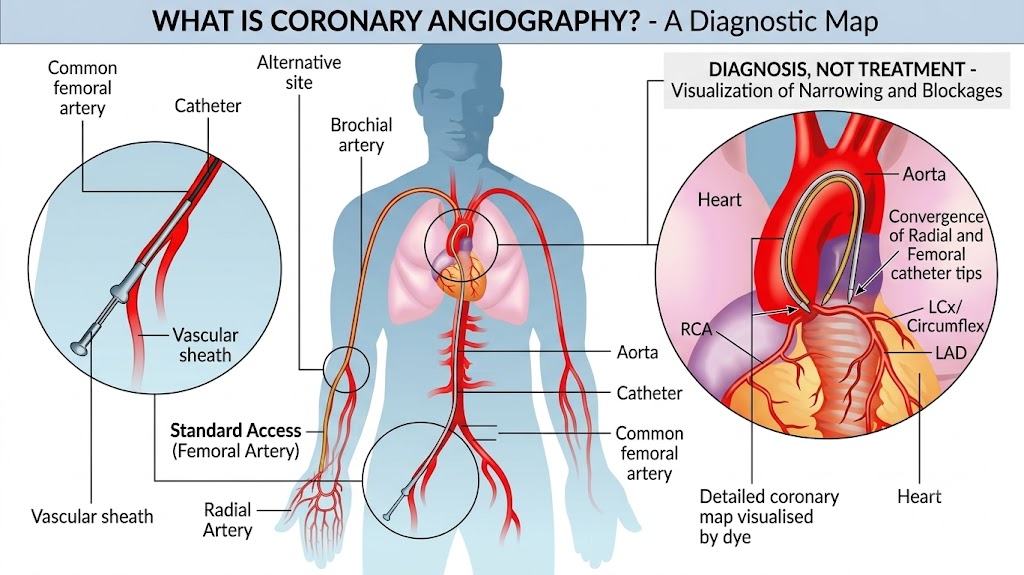
Coronary angiography is a diagnostic procedure that allows your cardiologist to see, in real time, exactly what is happening inside your heart’s arteries. A thin, flexible tube called a catheter is inserted — usually through the wrist — and guided to the coronary arteries. A small amount of contrast dye is then injected, which shows up clearly on X-ray imaging, revealing any narrowing, blockages, or abnormalities.
It is not a treatment. It is a map. A precise, detailed map of your heart’s blood supply — so your cardiologist can plan the safest and most effective path forward.
According to the American Heart Association, coronary angiography remains the gold standard for diagnosing coronary artery disease — and for good reason. No other test gives as complete a picture of the arteries as this procedure does
Your cardiologist may recommend coronary angiography if you have persistent chest pain that cannot be explained by other tests, an abnormal result on a Treadmill Test (TMT) or echocardiogram, a suspected heart attack, unexplained breathlessness or reduced heart function, or if you are being evaluated before a major heart surgery.
As per the World Health Organization, cardiovascular disease is the leading cause of death globally — and timely, accurate diagnosis is the single most important factor in improving outcomes. Coronary angiography is that diagnosis.
Myth 1: “Angiography is open-heart surgery — it is very risky.”
Fact: Coronary angiography is a minimally invasive procedure. There is no cutting open the chest, no general anaesthesia, and no stitches. It is done through a small puncture — usually at the wrist — and takes 30 to 60 minutes. Most patients go home the same day or the next morning.
Myth 2: “The dye used in angiography will damage my kidneys permanently.”
Fact: Contrast dye allergy or kidney stress is a real concern — but it is manageable and rare in patients with normal kidney function. Before the procedure, your cardiologist will check your kidney function tests. Patients with mild kidney issues are given special hydration protocols and low-dose dye. Severe reactions occur in less than 0.1% of cases.
Myth 3: “Angiography itself can cause a heart attack.”
Fact: The risk of a heart attack caused by angiography is extremely low — less than 0.05% in elective cases performed at experienced centres. The procedure is designed to diagnose heart problems, not cause them. The catheter does not block arteries — it simply passes through them.
Myth 4: “Once you have angiography, you will definitely need surgery next.”
Fact: Angiography is only a diagnostic test. It does not commit you to any treatment. Depending on what is found, your cardiologist may recommend medications and lifestyle changes, angioplasty with a stent, or bypass surgery — or nothing at all if the arteries look healthy. The results guide the decision; they do not force one.
Myth 5: “The radiation from angiography is harmful and causes cancer.”
Fact: Yes, angiography uses X-ray imaging — but the radiation dose is carefully controlled and well within safe limits. It is comparable to a few months of natural background radiation. Modern cath labs use advanced technology to minimise radiation exposure. For most patients, a single angiography poses no meaningful radiation risk.
Myth 6: “Recovery after angiography takes weeks — I cannot afford to rest that long.”
Fact: When done via the radial (wrist) approach — which is Dr. Harshal Ingle’s preferred technique — patients can walk within hours of the procedure. There is a small bandage at the wrist. Most patients return to desk work within 2 to 3 days. Heavy physical activity is restricted for about a week.
This is one of the most common concerns patients bring up before their Coronary Angiography Treatment Pune. The honest answer is: dye allergies do happen, but serious reactions are rare and thoroughly manageable at an experienced cardiac centre.
Mild reactions — such as a warm flushing sensation or mild itching — are relatively common and resolve quickly. Moderate reactions like hives or nausea are treated immediately with antihistamines. Severe anaphylactic reactions occur in less than 1 in 1,000 cases, and the catheterisation lab is always equipped to handle them.
If you have a known history of allergies — especially to iodine or seafood — inform your cardiologist before the procedure. A pre-medication protocol using steroids and antihistamines can significantly reduce the risk of any reaction.
| Diagnostic Coronary Angiography | ₹15,000 – ₹25,000 |
| Radial (wrist) approach · Same day discharge in most cases | |
| Angiography + Angioplasty (1 stent) | ₹1.2 – ₹2.5 Lakh |
| Angiography + Angioplasty (2 stents) | ₹2.5 – ₹4.5 Lakh |
| Pre-procedure Cardiac Consultation | ₹800 – ₹1,200 |
| Pre-procedure Blood Tests & ECG | ₹1,500 – ₹3,000 |
| Hospital Stay (if required, 1–2 nights) | ₹8,000 – ₹20,000 |
| Most health insurance & mediclaim policies cover angiography · Cashless facility available at Ruby Hall Clinic · Call us to verify your coverage | |
Dr. Harshal Ingle is the first cardiologist in Pune to perform Orbital Atherectomy for complex coronary blockages and Renal Denervation for resistant hypertension. With over 1,000 complex cardiac interventions and a 99.83% success rate, the expertise in this team is not incidental — it is intentional.
The catheterisation lab at Ruby Hall Clinic, Pune is equipped with advanced intravascular imaging technology, allowing Dr. Ingle to not just see the blockage, but understand its exact composition and plan the most precise treatment possible. Learn more about our advanced Intravascular Imaging capabilities.
Every patient at Good Heart Clinic receives a personal post-procedure briefing — Dr. Ingle sits with you and your family, shows you the actual images from your angiography, and explains exactly what was found and what it means for your future.
Do not wait. If chest pain lasts more than 5 minutes or comes with sweating or breathlessness, reach a cardiologist immediately. The first 60 minutes are the most critical for your heart.
Coronary Angiography is not something to fear — it is something to be grateful for. In a single, minimally invasive procedure, it gives your cardiologist a complete, clear picture of your heart’s health that no blood test or scan can replicate.
The myths around it — the fear of dye, the assumption of surgery, the worry about radiation — are understandable. But they should never be the reason a patient delays a diagnosis that could save their life.
If your doctor has recommended Coronary Angiography Treatment Pune, the team at Good Heart Clinic is here to walk you through every step — before, during, and after. You will never feel like a number here. You will feel like a patient whose heart genuinely matters.
We believe that every patient deserves absolute confidence in their care plan.
303, A, Choice Apartments Opp Vohuman Cafe , Dhole Patil Road , Pune
Support mail: drharshalingle@gmail.com
Opening Hours: Mon -Sat: 04.00 PM to 08.00 PM