Welcome to meidicross the leading medical facility for the health of you and your family.
Welcome to meidicross the leading medical facility for the health of you and your family.


Last updated: June 30, 2026
Q: How long is recovery after coronary angioplasty?
A: Most patients go home the same day or next morning after angioplasty. Light activity resumes within 2–3 days. Desk work within 1–2 weeks. Driving after 1 week (radial access). Full normal activity by week 4–6. Complete cardiac recovery — including stent stabilisation — takes approximately 3 months.
Q: What Indian foods are safe to eat after angioplasty?
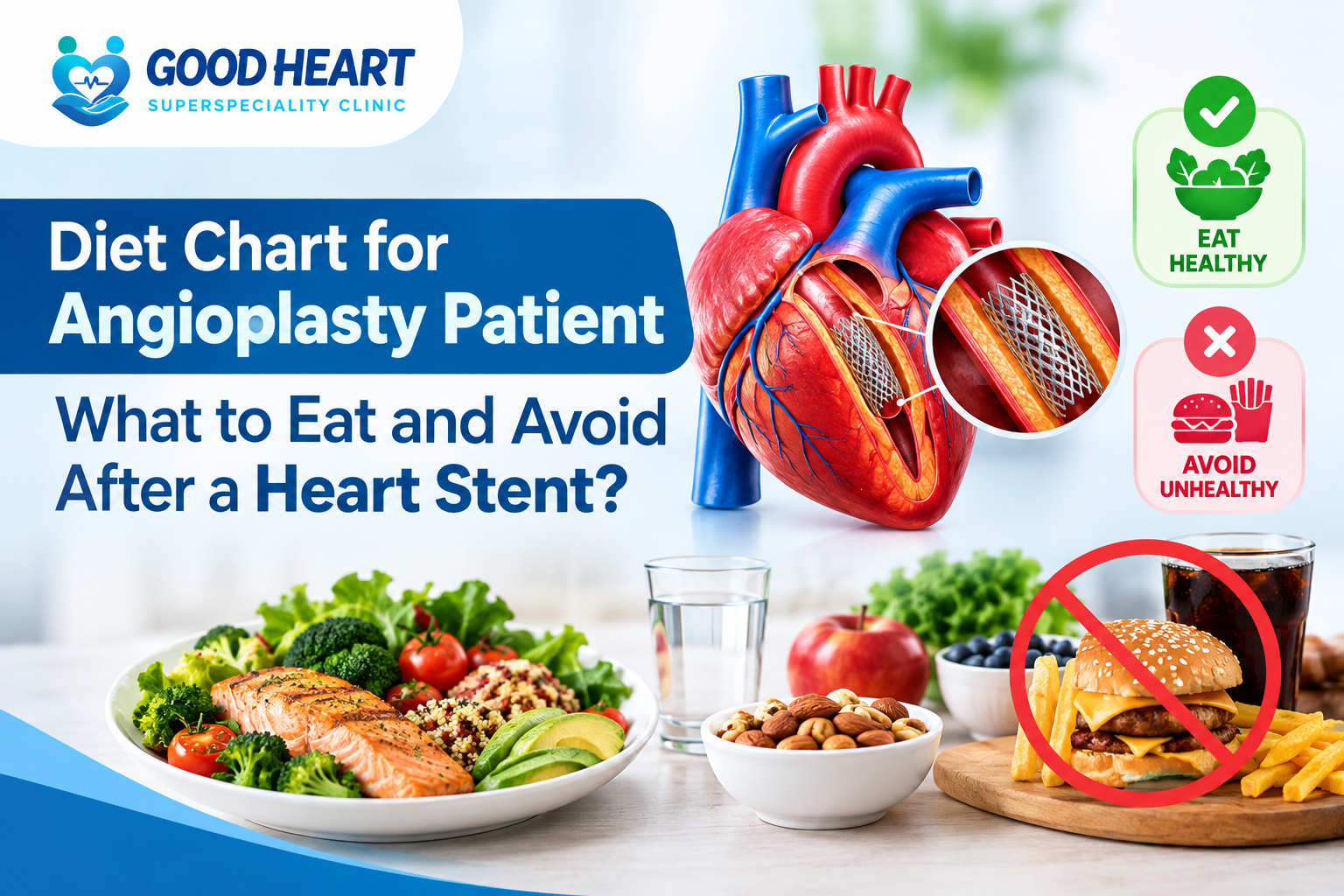
A: Safe Indian foods after angioplasty: dal, sabzi cooked in minimal oil, roti (1–2), brown rice, oats, poha, idli, curd (low-fat), fruits (banana, papaya, apple), and fish. Avoid: poori, paratha, ghee in excess, pickle, papad, fried snacks, and full-fat dairy for the first month.
Q: Can I stop my blood thinner tablet after angioplasty?
A: Never stop without doctor’s approval. Dual antiplatelet therapy (aspirin + clopidogrel/ticagrelor) must continue for a minimum of 6–12 months after a drug-eluting stent. Stopping early — even once — dramatically increases the risk of stent thrombosis, which can cause a fatal heart attack.
Q: When should I go to hospital after angioplasty?
A: Go immediately if your patient develops: new chest pain or tightness, sudden breathlessness at rest, dizziness or fainting, swelling or bleeding at the wrist site, fever above 38°C, or cold/numb hand on the procedure side. Do not wait — call the cardiac emergency number directly.
Q: When can a patient walk after angioplasty?
A: Same day — within 2–4 hours of a radial (wrist) angioplasty. Short, slow walks around the ward or home are encouraged from day one. By week 2, a 15–20 minute walk daily is the target. By week 4–6, 30-minute brisk walks are typically safe with cardiologist clearance.

If your cardiologist just told you that you need heart valve replacement surgery, your mind is probably racing. Is this as serious as it sounds? What actually happens during recovery? And most importantly — will it work?
I’ve spent the last seven years writing about cardiac care, interviewing surgeons, and following patient recovery journeys from the pre-op consultation to the six-month follow-up echocardiogram. In that time, one thing has become clear: heart valve replacement surgery is serious, but it’s also one of the most refined and successful procedures in modern cardiac medicine. The fear patients feel walking in rarely matches the outcomes they experience walking out.
This guide breaks down exactly how serious heart valve replacement surgery is, what the real risks are, what recovery looks like week by week, and what the success rate data actually shows.
Your heart has four valves — aortic, mitral, tricuspid, and pulmonic — that keep blood flowing in one direction through your heart’s chambers. When a valve narrows (stenosis) or leaks (regurgitation), your heart has to work harder to move blood, which can lead to fatigue, shortness of breath, chest pain, swelling, and eventually heart failure if left untreated.
Valve disease can result from congenital defects, age-related calcium buildup, rheumatic fever, infection (endocarditis), or damage after a heart attack. When a valve is too damaged to repair, replacement becomes the recommended path. Left untreated, severe valve disease carries a mortality risk that is significantly higher than the surgery itself — which is an important piece of context often missing from the “how risky is this surgery” conversation.
Any procedure that involves opening the chest or working inside the heart is, by definition, major surgery. It requires anesthesia, a hospital stay, and a real recovery period. In that sense, yes — it’s serious.
But “serious” doesn’t mean “high-risk” in the way many patients assume. Heart valve replacement is one of the most performed and most studied cardiac procedures worldwide, and outcomes have improved dramatically over the past two decades thanks to minimally invasive techniques and transcatheter approaches.
There are three main ways surgeons perform valve replacement:
The right approach depends on which valve is affected, your age, overall health, anatomy, and how many valves need attention.
No surgery is without risk, and it’s fair for patients to want a clear-eyed picture before consenting to the procedure. Potential risks include:
Your individual risk profile depends heavily on age, kidney function, prior heart surgeries, diabetes, and general frailty. Surgeons often use a scoring tool called the STS (Society of Thoracic Surgeons) risk score to estimate your personal risk before surgery — ask your care team for your number and what it means.
One decision that affects your long-term risk profile is the type of replacement valve:
This is a conversation worth having in detail with your cardiologist, since the “right” valve depends heavily on your age, lifestyle, and future pregnancy plans if applicable.
Recovery looks different depending on which procedure you have, but here’s a general roadmap:
Days 1–3 (Hospital, ICU/step-down unit): You’ll be closely monitored for heart rhythm, bleeding, and infection. Open-heart patients typically spend a night or two in intensive care before moving to a regular cardiac unit. TAVR patients often go home within 1–3 days.
Week 1–2 (Early home recovery): Fatigue is normal and expected. Open-heart patients will have activity restrictions — no lifting over 5–10 pounds, no driving, and careful management of the sternal incision as the breastbone begins to heal.
Weeks 3–6: Energy gradually improves. Most patients start a structured cardiac rehabilitation program during this window, which combines supervised exercise with education on heart-healthy habits.
Weeks 6–12: For open-heart surgery patients, the breastbone is typically healed enough to resume more normal activity, including driving and light exercise, with clearance from your surgeon. TAVR patients often reach this stage of recovery much faster, sometimes within 2–3 weeks.
3–6 months: Most patients report feeling “like themselves again,” often with more energy than they had before surgery since the heart is no longer straining against a damaged valve.
Full recovery from open-heart surgery can take up to 3 months for physical healing and up to 6 months to feel fully back to baseline energy. TAVR recovery is typically faster, often measured in weeks rather than months.
This is the number most patients actually want: how likely is this to work?
Across multiple hospital systems and published studies, heart valve replacement surgery has a reported success rate ranging from roughly 90% to 98%, depending on the valve involved, the surgical approach, and the patient’s overall health going in. For isolated aortic valve replacement in otherwise healthy patients, the operative mortality risk is generally in the range of 1–3%, meaning the vast majority of patients not only survive the procedure but see meaningful improvement in symptoms and quality of life.
Five-year survival rates for aortic valve replacement are commonly cited in the range of 85% to 94%, with large trials showing TAVR and open-heart surgery producing comparable long-term survival outcomes in lower-risk patients. Long-term studies also show mechanical valves have a lower rate of valve failure over 15 years compared to biological valves, though this comes with the trade-off of lifelong blood thinners.
It’s worth remembering that “success” isn’t just about survival — it’s also about symptom relief. Most patients experience a significant reduction in shortness of breath, chest pain, and fatigue within weeks of recovery, along with improved ability to exercise and go about daily life.
It’s considered major surgery, similar in seriousness to coronary bypass surgery. However, it’s also one of the most commonly performed and well-studied cardiac procedures, with success rates generally between 90% and 98%.
Open-heart valve replacement typically requires 6–12 weeks for the chest incision to heal and up to 3–6 months to feel fully recovered. Minimally invasive and TAVR procedures often cut this timeline significantly, sometimes to just a few weeks.
Most data puts the success rate between 90% and 98%, with operative mortality risk generally around 1–3% for isolated valve replacement in otherwise healthy patients. Success rates vary based on age, valve type, and overall health
TAVR is less invasive and generally has a shorter recovery time, and studies show comparable survival outcomes to open-heart surgery in low- and intermediate-risk patients. However, TAVR isn’t suitable for every valve condition or every patient — your cardiologist will help determine the best option for your anatomy and risk profile.
Mechanical valves often last a lifetime but require lifelong blood thinners. Biological (tissue) valves typically last 10–20 years and may need replacement later, particularly in younger patients.
The main risks include bleeding, infection, irregular heart rhythm, stroke, kidney injury, and the potential need for a pacemaker. Your personal risk depends on age, overall health, and any pre-existing conditions.
Yes — most patients return to normal or near-normal daily activity within a few months and often report better energy and quality of life than before surgery, since the heart no longer has to work against a damaged valve.
Heart valve replacement surgery is major surgery, and it deserves to be taken seriously — but the data is genuinely reassuring. Modern techniques, experienced surgical teams, and decades of refinement have made this one of the safer major cardiac procedures available today, with high success rates and strong long-term survival. The most important thing you can do is choose an experienced valve center, understand your personal risk factors, and go into surgery with realistic, well-informed expectations.
Book your post-angioplasty follow-up consultation today. Your stent is doing its job. Make sure everything around it is too.
Morning OPD — Cardiac OPD C7, Ground Floor, Building 3, Ruby Hall Clinic, Pune 411001 Evening OPD — 303A, Choice Apartments, Opp. Vohuman Cafe, Dhole Patil Road, Pune 411001 Appointments: 9822055445 / 8208950831 Cardiac Emergency: 9697020666 / 7722031119 goodheartclinic.com
OPD Timings: Monday to Saturday | Morning: 10 AM – 4 PM | Evening: 4 PM – 8 PM
We believe that every patient deserves absolute confidence in their care plan.
303, A, Choice Apartments Opp Vohuman Cafe , Dhole Patil Road , Pune
Support mail: drharshalingle@gmail.com
Opening Hours: Mon -Sat: 04.00 PM to 08.00 PM