

Electrocardiogram (EKG or ECG)
Advanced ECG testing to keep every heartbeat protected.
Electrocardiogram (EKG or ECG) Testing
Overview
An Electrocardiogram—commonly called an EKG or ECG—is one of the most fundamental and valuable tests in cardiology. This simple, painless, non-invasive test records your heart’s electrical activity and provides critical information about your heart rhythm, rate, and overall cardiac health in just a few minutes.
At Good Heart Clinic, we perform EKGs using advanced equipment and experienced interpretation by our expert cardiologists. Whether you’re experiencing concerning symptoms, need routine screening, or require pre-surgical clearance, an EKG provides immediate, actionable insights into your heart’s electrical function. Best of all, the test is completely painless, takes less than 10 minutes, and you can resume normal activities immediately afterward.
Electrocardiogram (ECG) in Pune | Accurate Heart ECG Test
If you are looking for a reliable electrocardiogram in Pune, Good Heart Clinic provides accurate ECG testing for early detection of heart rhythm abnormalities and other cardiac conditions.An ECG test in Pune records the electrical activity of your heart and helps diagnose arrhythmias, heart attacks, and other cardiovascular issues.
What is a Electrocardiogram ?
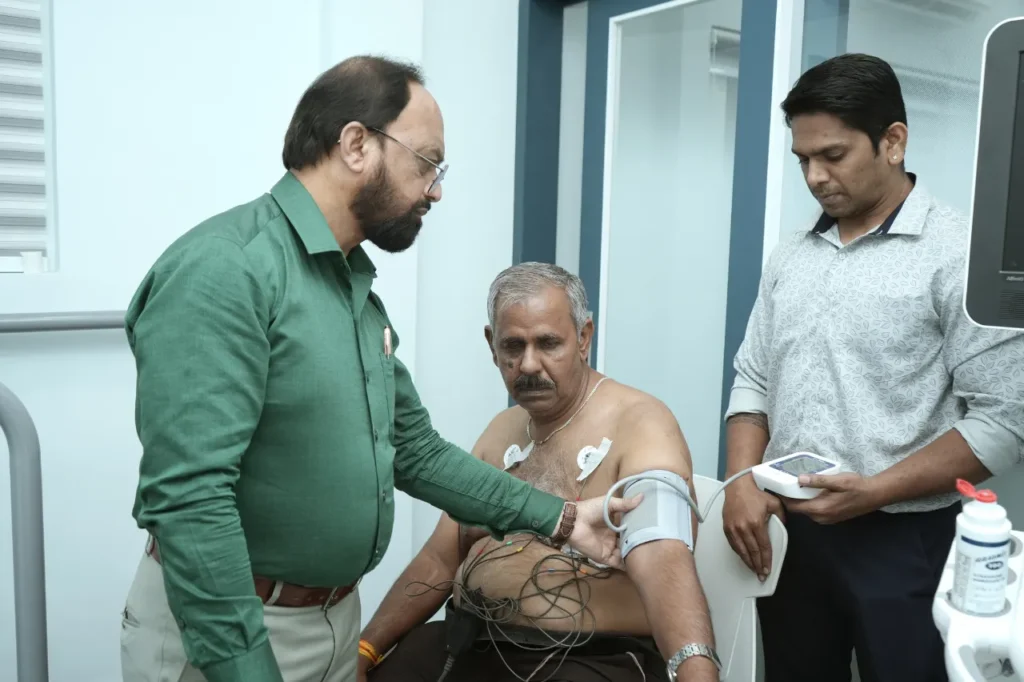
An ECG/EKG is a non-invasive test that records the electrical activity of your heart through small sensors placed on your chest, arms, and legs. Every heartbeat produces an electrical impulse, and the ECG machine captures these signals as waveforms.
How It Works
Your heart has a natural electrical system that coordinates each heartbeat:
- Electrical impulses originate in the sinoatrial (SA) node, your heart’s natural pacemaker
- The signal travels through the upper chambers (atria), causing them to contract
- The impulse continues to the lower chambers (ventricles), triggering a stronger contraction that pumps blood throughout your body
- This cycle repeats 60-100 times per minute at rest in a healthy adult
Types of EKG/ECG Test
Good Heart Clinic offers several types of EKG testing depending on your specific needs:
Resting EKG
You lie still on an examination table for a few minutes while electrodes placed on your chest, arms, and legs record your heart's electrical activity at rest.
Exercise Stress EKG
EKG recording performed while you walk on a treadmill with progressively increasing intensity, monitoring how your heart responds to physical stress.
Holter Monitor (24-48 Hour Continuous EKG)
A portable EKG device you wear continuously for 24-48 hours while going about your normal daily activities, recording every heartbeat during that time.
Event Monitor
A portable recording device worn for days to weeks that you activate when you feel symptoms, capturing your heart rhythm during concerning episodes.
Symptoms
Chest Discomfort
If you feel tightness or pressure in your chest during activity.
Shortness of Breath
If normal walking or mild exercise leaves you breathless.
High Blood Pressure
If your BP fluctuates or remains higher than usual.
Irregular Heartbeats
If you notice skipped beats, fluttering, or unusual heart rhythm.
Lightheadedness
If you frequently feel unsteady or close to fainting.
Unexplained Tiredness
If low energy affects your daily activities despite resting.
Heavy Heartbeats
If your heart suddenly races or beats forcefully without reason.
Stress-Triggered Discomfort
If anxiety or emotional strain brings on chest or heart-related sensations.
Benefits
Early Detection of Heart Disease
Diagnoses Heart Rhythm Disorders
Non-Invasive and Completely Safe
Detects Silent Heart Problems
Preparations
One of the best things about an EKG is that it requires minimal preparation. However, following these simple guidelines ensures the most accurate results and a smooth testing experience:
General Pre-Test Guidelines
Wear Comfortable, Accessible Clothing
Skin Preparation
Special Situations
For Athletes:
- Avoid intense workouts on the morning of your EKG
- Mention your athletic training to the technician (athletes often have different “normal” EKG patterns)
For Pediatric Patients:
- Parents should explain the test to children in age-appropriate terms
- Emphasize that it doesn’t hurt and takes only a few minutes
- Bring a favorite toy or comfort item for young children
- Children should wear easy-to-remove clothing
What NOT to Do
Procedure
Step 1: Preparation (3-5 minutes)
Clothing Removal:
- You’ll be asked to remove your shirt and any undergarments covering your chest
- Women may be given a hospital gown that opens in the front for privacy
- You can keep your pants or skirt on
- Socks and shoes typically stay on unless electrodes are needed on the ankle.
Skin Preparation:
To ensure the electrodes stick properly and provide clear signals:
- The technician will clean electrode sites with alcohol wipes to remove oils
- Small areas of chest hair may need to be shaved or trimmed if necessary (typically only 1-2 inch patches)
- Your skin may be gently rubbed with a rough pad to improve electrode contact
- This preparation is quick and causes no pain—at most, slight brief discomfort
Step 2: Electrode Placement (2-3 minutes)
Attaching the Sensors
The technician will place 10 small adhesive electrodes (also called leads) on specific locations:
Chest Electrodes (6 electrodes):
- Placed across your chest in a specific pattern
- Positioned between and below your ribs on the left side
- Each electrode is about the size of a quarter
Limb Electrodes (4 electrodes):
- One on each arm (usually on the inner wrists or upper arms)
- One on each leg (usually on the inner ankles or lower legs)
What the Electrodes Feel Like:
- They’re sticky adhesive patches, similar to large band-aids
- You’ll feel slight coolness from the adhesive gel
- They don’t hurt at all—no needles, no electrical shock, no discomfort
- They simply detect the electrical signals your heart naturally produces
Wire Connections:
- Thin wires connect each electrode to the EKG machine
- These wires don’t deliver electricity—they only receive signals from your heart
- You won’t feel anything from the wires
Step 3: The Recording (10-30 seconds)
Once everything is connected:
- The technician will ask you to lie very still and breathe normally
- Don’t talk during the recording (it can affect results)
- Try to relax and let your body rest naturally
- The machine will record your heart’s electrical activity
What’s Happening:
- The EKG machine measures the tiny electrical signals traveling through your heart
- These signals are amplified and displayed as waves on a screen or printed on paper
- The entire recording takes only 10-30 seconds
- You won’t feel anything during the recording—no sensations, no discomfort
Step 4: Completion and Cleanup (1-2 minutes)
Once the recording is complete:
- The technician will disconnect the wires
- The adhesive electrodes will be gently peeled off
- This doesn’t hurt, though you may have slight residual adhesive on your skin
- You can wipe off any remaining adhesive gel with provided tissues or wipes
Frequently Asked Question (FAQs)
An ECG provides a visual representation of your heart rhythm, heart rate, and electrical patterns. It can quickly identify arrhythmias, ischemia, heart block, electrolyte imbalances, and other abnormalities. It is commonly used alongside TMT, 2D Echo, and Holter Monitoring for a complete cardiac evaluation.
You may need an ECG if you have chest discomfort, palpitations, dizziness, shortness of breath, uncontrolled blood pressure, or a family history of heart disease. It is also recommended for people with diabetes, thyroid disorders, and high cholesterol, as these conditions increase cardiac risk.
Yes, an ECG is one of the most effective tests to detect ongoing or previous heart attacks, changes in heart muscle, and abnormalities in blood flow. If the ECG is abnormal, your cardiologist may recommend cardiac enzymes, 2D Echo, or coronary angiography for further clarity.
A standard resting ECG takes 5–10 minutes, making it one of the fastest and most convenient cardiac tests. Reports are generated immediately and interpreted by experienced cardiologists for instant results.
An ECG can detect electrical abnormalities and signs of reduced blood flow, but it does not confirm the severity of blockages. For detailed assessment, doctors may advise Treadmill Stress Test (TMT), CT Coronary Angiography, or Coronary Angiogram.